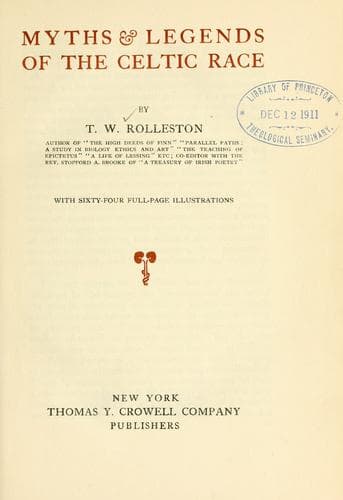
Myths & Legends of the Celtic RaceRolleston, T. W. (Thomas William)
Religion
Myths & Legends of the Celtic Race
Rolleston, T. W. (Thomas William)
Celts -- Religion; Mythology, Celtic
It was not merely that they changed it; they left it behind them so
entirely that all record of it is lost. St. Patrick, himself a Celt, who
apostolised Ireland during the fifth century, has left us an
autobiographical narrative of his mission, a document of intense interest,
and the earliest extant record of British Christianity; but in it he tells
us nothing of the doctrines he came to supplant. We learn far more of
Celtic religious beliefs from Julius Cæsar, who approached them from quite
another side. The copious legendary literature which took its present form
in Ireland between the seventh and the twelfth centuries, though often
manifestly going back to pre-Christian sources, shows us, beyond a belief
in magic and a devotion to certain ceremonial or chivalric observances,
practically nothing resembling a religious or even an ethical system. We
know that certain chiefs and bards offered a long resistance to the new
faith, and that this resistance came to the arbitrament of battle at
Moyrath in the sixth century, but no echo of any intellectual controversy,
no matching of one doctrine against another, such as we find, for
instance, in the records of the controversy of Celsus with Origen, has
reached us from this period of change and strife. The literature of
ancient Ireland, as we shall see, embodied many ancient myths; and traces
appear in it of beings who must, at one time, have been gods or elemental
powers; but all has been emptied of religious significance and turned to
romance and beauty. Yet not only was there, as Cæsar tells us, a very
well-developed religious system among the Gauls, but we learn on the same
authority that the British Islands were the authoritative centre of this
system; they were, so to speak, the Rome of the Celtic religion.
What this religion was like we have now to consider, as an introduction to
the myths and tales which more or less remotely sprang from it.
*The Popular Religion of the Celts*
But first we must point out that the Celtic religion was by no means a
simple affair, and cannot be summed up as what we call “Druidism.” Beside
the official religion there was a body of popular superstitions and
observances which came from a deeper and older source than Druidism, and
was destined long to outlive it—indeed, it is far from dead even yet.
*The Megalithic People*
Public-domain text, read in full here on John Shaqi.
Reviews
Reviews
No reviews yet
Be the first to share your thoughts on this work.
Join the Discussion
Join the discussion
Sign in to leave a comment or review.
Sign InorCreate an account