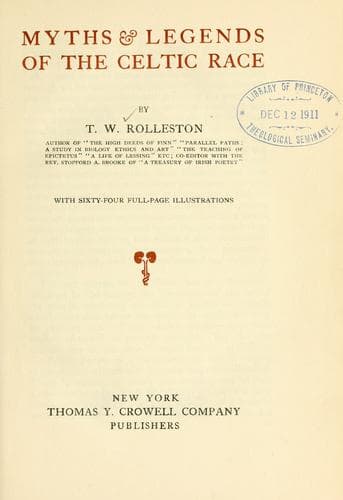
Myths & Legends of the Celtic RaceRolleston, T. W. (Thomas William)
Religion
Myths & Legends of the Celtic Race
Rolleston, T. W. (Thomas William)
Celts -- Religion; Mythology, Celtic
The history of this people during the time when they were the dominant
power in Mid-Europe has to be divined or reconstructed from scattered
references, and from accounts of episodes in their dealings with Greece
and Rome, very much as the figure of a primæval monster is reconstructed
by the zoologist from a few fossilised bones. No chronicles of their own
have come down to us, no architectural remains have survived; a few coins,
and a few ornaments and weapons in bronze decorated with enamel or with
subtle and beautiful designs in chased or repoussé work—these, and the
names which often cling in strangely altered forms to the places where
they dwelt, from the Euxine to the British Islands, are well-nigh all the
visible traces which this once mighty power has left us of its
civilisation and dominion. Yet from these, and from the accounts of
classical writers, much can be deduced with certainty, and much more can
be conjectured with a very fair measure of probability. The great Celtic
scholar whose loss we have recently had to deplore, M. d’Arbois de
Jubainville, has, on the available data, drawn a convincing outline of
Celtic history for the period prior to their emergence into full
historical light with the conquests of Cæsar,(3) and it is this outline of
which the main features are reproduced here.
*The True Celtic Race*
To begin with, we must dismiss the idea that Celtica was ever inhabited by
a single pure and homogeneous race. The true Celts, if we accept on this
point the carefully studied and elaborately argued conclusion of Dr. T.
Rice Holmes,(4) supported by the unanimous voice of antiquity, were a
tall, fair race, warlike and masterful,(5) whose place of origin (as far
as we can trace them) was somewhere about the sources of the Danube, and
who spread their dominion both by conquest and by peaceful infiltration
over Mid-Europe, Gaul, Spain, and the British Islands. They did not
exterminate the original prehistoric inhabitants of these
regions—palæolithic and neolithic races, dolmen-builders and workers in
bronze—but they imposed on them their language, their arts, and their
traditions, taking, no doubt, a good deal from them in return, especially,
as we shall see, in the important matter of religion. Among these races
the true Celts formed an aristocratic and ruling caste. In that capacity
they stood, alike in Gaul, in Spain, in Britain, and in Ireland, in the
forefront or armed opposition to foreign invasion. They bore the worst
brunt of war, of confiscations, and of banishment. They never lacked
valour, but they were not strong enough or united enough to prevail, and
they perished in far greater proportion than the earlier populations whom
they had themselves subjugated. But they disappeared also by mingling
their blood with these inhabitants, whom they impregnated with many of
their own noble and virile qualities. Hence it comes that the
characteristics of the peoples called Celtic in the present day, and who
Public-domain text, read in full here on John Shaqi.
Reviews
Reviews
No reviews yet
Be the first to share your thoughts on this work.
Join the Discussion
Join the discussion
Sign in to leave a comment or review.
Sign InorCreate an account