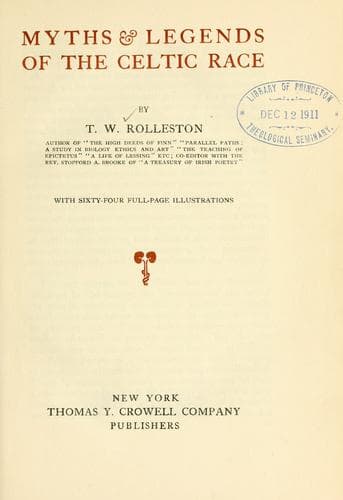
Myths & Legends of the Celtic RaceRolleston, T. W. (Thomas William)
Religion
Myths & Legends of the Celtic Race
Rolleston, T. W. (Thomas William)
Celts -- Religion; Mythology, Celtic
This deity is one of the most popular in Irish mythology. He was lord of
the sea, beyond or under which the Land of Youth or Islands of the Dead
were supposed to lie; he therefore was the guide of man to this country.
He was master of tricks and illusions, and owned all kinds of magical
possessions—the boat named Ocean-sweeper, which obeyed the thought of
those who sailed in it and went without oar or sail, the steed Aonbarr,
which could travel alike on sea or land, and the sword named The Answerer,
which no armour could resist. White-crested waves were called the Horses
of Mananan, and it was forbidden (_tabu_) for the solar hero, Cuchulain,
to perceive them—this indicated the daily death of the sun at his setting
in the western waves. Mananan wore a great cloak which was capable of
taking on every kind of colour, like the widespread field of the sea as
looked on from a height; and as the protector of the island of Erin it was
said that when any hostile force invaded it they heard his thunderous
tramp and the flapping of his mighty cloak as he marched angrily round and
round their camp at night. The Isle of Man, seen dimly from the Irish
coast, was supposed to be the throne of Mananan, and to take its name from
this deity.
*The Goddess Dana*
The greatest of the Danaan goddesses was Dana, “mother of the Irish gods,”
as she is called in an early text. She was daughter of the Dagda, and,
like him, associated with ideas of fertility and blessing. According to
d’Arbois de Jubainville, she was identical with the goddess Brigit, who
was so widely worshipped in Celtica. Brian, Iuchar, and Iucharba are said
to have been her sons—these really represent but one person, in the usual
Irish fashion of conceiving the divine power in triads. The name of Brian,
who takes the lead in all the exploits of the brethren,(98) is a
derivation from a more ancient form, Brenos, and under this form was the
god to whom the Celts attributed their victories at the Allia and at
Delphi, mistaken by Roman and Greek chroniclers for an earthly leader.
*The Morrigan*
There was also an extraordinary goddess named the Morrigan,(99) who
appears to embody all that is perverse and horrible among supernatural
powers. She delighted in setting men at war, and fought among them
herself, changing into many frightful shapes and often hovering above
fighting armies in the aspect of a crow. She met Cuchulain once and
proffered him her love in the guise of a human maid. He refused it, and
she persecuted him thenceforward for the most of his life. Warring with
him once in the middle of the stream, she turned herself into a
water-serpent, and then into a mass of water-weeds, seeking to entangle
and drown him. But he conquered and wounded her, and she afterwards became
his friend. Before his last battle she passed through Emain Macha at
night, and broke the pole of his chariot as a warning.
*Cleena’s Wave*
Public-domain text, read in full here on John Shaqi.
Reviews
Reviews
No reviews yet
Be the first to share your thoughts on this work.
Elsewhere in the archive
Join the Discussion
Join the discussion
Sign in to leave a comment or review.
Sign InorCreate an account