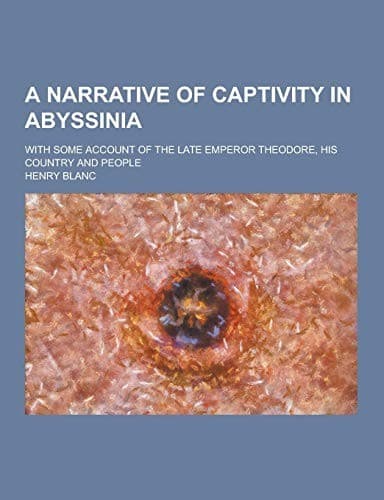
Narrative of Captivity in Abyssinia with Some Account of the Late Emperor the Late Emperor Theodore, His Country and PeopleBlanc, Henry
History
Narrative of Captivity in Abyssinia with Some Account of the Late Emperor the Late Emperor Theodore, His Country and People
Blanc, Henry
Abyssinian Expedition (1867-1868); Ethiopia -- History -- 1490-1889; Theodore II, Negus of Ethiopia, -1868
Theodore, when detailing to us his grievances one day on our way
to Agau Medar, introduced the subject of his quarrel with the Abouna.
He then stated as the reason of his enmity against him that, one
day when he was entertaining his officers at a public breakfast,
the Bishop, taking advantage of his absence, and under pretence of
confessing the Queen, went into her tent. When Theodore returned
after the breakfast was over, he presented himself at the door of
his wife's apartment, but on being informed that she was engaged
in her religious duties with the Abouna he walked away. In the
evening he returned again to his wife's tent. When he entered, she
flew to him, and sobbing on his neck told him that she had been
that day unwillingly unfaithful to him, having been unable to resist
the violence of the Bishop. He forgave her, he said, because she
was innocent; and as for the suborner of his honour he could not
punish him: nothing but death could avenge such a crime, and how
could he lay violent hands on a dignitary of the Church?--There is
no doubt that the whole was an abominable invention; but Theodore
had evidently told the same story over and over again until at last
he had come to believe it himself.
Abouna Salama lost reputation, though, perhaps, few people believed
the Emperor's assertion. But on the principle that if you throw mud
some will stick, the Abouna's character was amongst a certain class
fairly gone; and henceforward his friends were only to be found
amongst the King's enemies, while his foes were Theodore's bosom
friends. In public Theodore still always treated him with respect,
though not with such a great show of humility as before; but he
evidently, for the sake of his people, made a distinction between
the official character of the Abouna, respecting it on account of
his Christian faith, and his private one, for which he expressed
the greatest scorn.
Public-domain text, read in full here on John Shaqi.
Reviews
Reviews
No reviews yet
Be the first to share your thoughts on this work.
Elsewhere in the archive
Join the Discussion
Join the discussion
Sign in to leave a comment or review.
Sign InorCreate an account