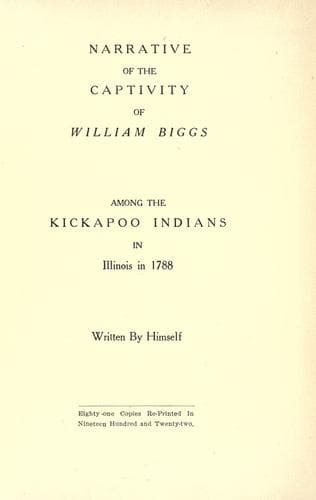
Narrative of the Captivity of William Biggs among the Kickapoo Indians in Illinois in 1788 — John Shaqi
Narrative of the Captivity of William Biggs among the Kickapoo Indians in Illinois in 1788Biggs, William
History
Narrative of the Captivity of William Biggs among the Kickapoo Indians in Illinois in 1788
Biggs, William
Indian captivities; Kickapoo Indians
One of the Indians had a handkerchief tied around his head and
was carrying a gun; the other had a cocked hat on his head, and had a
large sword. The warriors never let on that they saw them, but continued
dancing about fifteen minutes. After the two Indians and squaw came up
the warriors quit dancing, and went to them and shook hands; they
appeared very glad to see each other. The captain of the warriors then
talked with them about half an hour, and appeared to be very serious in
their conversation. The captain then told me I must go with them two
Indians and squaw. The sun was just then setting; the two Indians looked
very much pleased. I did not want to go with them, as I knew not where
they were going, and would have rather remained with the warriors that
took me, as I had got acquainted with them, but the captain told me I
must go with the two Indians and squaw, and that they were very good
Indians. The Indian that had the sword rode up to a stump and told me
to get up behind him on his horse; I did so with great reluctance, as I
knew not where they were going; they looked very much like warriors.
However, they started off very lively, and the Indian that I was riding
behind began to plague and joke the squaw about me; she was his
sister-in-law. He was an Indian that was full of life and very funny.
When I got acquainted with him I was well pleased with him. We traveled
about ten miles that evening before we reached the place they resided.
They were then living at a sugar camp, where they had made sugar that
spring, on the west bank of the Wabash, about ten miles below the old
Kickapoos' trading town, opposite to the Weawes town. We arrived at
their sugar camp about two hours in the night. They then gave me to an
old Kickapoo chief, who was the father of the Indian that carried the
gun, and the squaw, and the father-in-law of the funny Indian. The old
chief soon began to inquire of me where I lived, and where the Indians
caught me. I told him. He then asked me if they did not kill an Indian
when they took me prisoner. I told him no, there was no body with me but
one man and he had no gun. He then asked me again, if the Indians did
not kill one of their own men when they took me. I told him I did not
know; the captain told me they did, but I did not see them kill him. The
old chief then told me that it was true, they did kill him, and said he
was a bad Indian, he wanted to kill me. By this time the young squaw,
the daughter of the old chief, whom I traveled in company with that
evening, had prepared a good supper for me; it was hominy beat in a
mortar, as white and as handsome as I ever saw, and well cooked; she
fried some dried meat, pounded very fine in a mortar, in oil, then
sprinkled sugar very plentifully over it. I ate very hearty; indeed, it
was all very good and well cooked. When I was done eating, the old
chief told me to eat more. I told him I had eat enough. He said no, if I
did not eat more I could not live.
Public-domain text, read in full here on John Shaqi.
Reviews
Reviews
No reviews yet
Be the first to share your thoughts on this work.
Join the Discussion
Join the discussion
Sign in to leave a comment or review.
Sign InorCreate an account