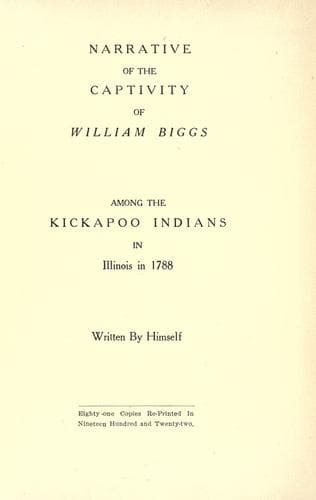
Narrative of the Captivity of William Biggs among the Kickapoo Indians in Illinois in 1788Biggs, William
History
Narrative of the Captivity of William Biggs among the Kickapoo Indians in Illinois in 1788
Biggs, William
Indian captivities; Kickapoo Indians
shoulders, it fell down. I turned round and picked it up, it was a very
old, dirty, lousy blanket, though it was better than nothing, as the day
was very cold. We travelled about five or six miles that evening, then
encamped in the woods. I suffered very much that night from the cold.
The tenth day we traveled five or six miles in the morning. We got
within a quarter of a mile of a new town, on the west bank of the Wabash
river, where those warriors resided, about nine o'clock, and made a halt
at a running branch of water, where the timber was very thick, so that
they could conceal themselves from the view of the town. Then they
washed themselves all over and dressed themselves with paint of
different colors. They made me wash, then they painted me and said I was
a Kickapoo. Then they cut a pole and pealed it, painted it different
colors and stuck the big end in the ground, and cleared a ring around
the pole for to dance in. The fifth night they cut a lock of hair out of
the crown of my head about as thick as my finger, plaited it elegantly
and put it in their conjuring bag, and hung that bag on the pole they
contemplated dancing around, and said that was their prisoner, and I was
a Kickapoo, and must dance with them. When they all got ready to dance,
the captain gave three very loud halloes, then walked into the ring and
the rest all followed him. They placed me the third next to the captain;
they then began to sing and dance. When we had danced about half an
hour, I saw several old men, boys and squaws come running to where we
were dancing. When there were a considerable number of them collected,
the captain stepped out of the ring and spoke to the squaws. He told
them to carry his and the other warriors' budgets to the town; the
captain then joined the other warriors and me in the dancing ring; he
marched in the front and we danced and sung all the way from there into
the town. Some of the old Indian warriors marched upon each side of us,
and at times would sing and dance until we got into their town. We
continued dancing until we got through the town to the war-post, which
stood on the west bank of the Wabash river; danced round that about
twenty minutes; they then marched into the town, took all the cords off
me, and showed me a cabin, told me to go in there, they were good
Indians, they would give me something to eat; I need not fear, as they
would not hurt me. I accordingly went in, where I received a plenty to
eat and was treated very kindly. The warriors went into other cabins and
feasted very greedily. We had not eat anything that morning nor the
night before. About one hour and a half before the sun set the same
evening, the warriors went out to the war-post again to dance. They took
me with them; several other Indians were present. They had danced about
half an hour when I saw two Indian men and a squaw riding a horseback
across the Wabash river, from the east side; they came to where we were
dancing.
Public-domain text, read in full here on John Shaqi.
Reviews
Reviews
No reviews yet
Be the first to share your thoughts on this work.
Join the Discussion
Join the discussion
Sign in to leave a comment or review.
Sign InorCreate an account