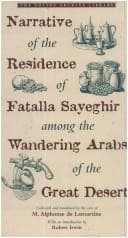
Narrative of the residence of Fatalla Sayeghir among the wandering Arabs of the great desertLamartine, Alphonse de
History
Narrative of the residence of Fatalla Sayeghir among the wandering Arabs of the great desert
Lamartine, Alphonse de
Arabian Peninsula -- Description and travel
The inhabitants of Saddad are brave, but gentle. We unpacked our goods,
and spent some days with them, to prove that we were really merchants.
The women bought much of our red cotton cloth, to make chemises. The
sale did not detain us long, but we were obliged to await the arrival
of the Bedouins in the environs. One day, having been told that there
was four hours from the village a considerable ruin, and very ancient,
in which was a natural vapour bath, the wonder excited our curiosity;
and M. Lascaris, desirous of seeing it, begged the sheik to give us an
escort. After marching four hours to the southeast, we arrived in the
midst of an extensive ruin, in which there remains only one habitable
room. The architecture is simple; but the stones are of prodigious
size. On entering the room, we perceived an opening two feet square,
from which issued a thick vapour; we threw into it a handkerchief, and
in a minute and a half, by the watch, it was thrown out and fell at our
feet. We repeated the experiment with a shirt, which, at the end of ten
minutes, returned like the handkerchief. Our guides assured us that a
machlas, which weighs ten pounds, would be thrown up in the same manner.
Having undressed, and placed ourselves around the opening, we were in a
short time covered with perspiration, which trickled down our bodies;
but the smell of the vapour was so detestable, that we could not remain
a long time exposed to it. After half an hour we put on our clothes,
and experienced a most delightful sensation. We were told that the
vapour was really very sanative, and cured numbers of sick. Returning
to the village, we supped with an excellent appetite; and never,
perhaps, did I enjoy a more delicious sleep.
Having nothing more to see at Saddad, or the neighbourhood, we
determined to set out for the village of Corietain. When we spoke of
this to Naufal, he advised us to change our names, as our own would
create suspicion in the Bedouins and the Turks. From that time M.
Lascaris took the name of Sheik Ibrahim el Cabressi (the Cyprian,) and
gave me that of Abdallah el Katib.
Public-domain text, read in full here on John Shaqi.
Reviews
Reviews
No reviews yet
Be the first to share your thoughts on this work.
Join the Discussion
Join the discussion
Sign in to leave a comment or review.
Sign InorCreate an account