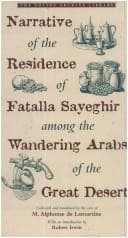
Narrative of the residence of Fatalla Sayeghir among the wandering Arabs of the great desertLamartine, Alphonse de
History
Narrative of the residence of Fatalla Sayeghir among the wandering Arabs of the great desert
Lamartine, Alphonse de
Arabian Peninsula -- Description and travel
flocks, and do them all the mischief possible: the God of battle will
give the victory to whom he pleases: but as to you, you have nothing
to fear.” Having thanked Naura, I withdrew well satisfied with having
gained her confidence.
Sheik Ibrahim, informed by me of all the wife of Nasser had told me,
said that it caused him the greatest vexation. “I was endeavouring,”
added he, “to attach myself to a tribe hostile to the Osmanlis, and
here I am with a chief allied to them.” I did not dare ask the meaning
of these words, but they served to set me thinking.
About sunset three hundred horsemen assembled beyond the encampment,
and marched early in the morning, having at their head Nasser, Hamed,
and Zamel. Three days afterwards a messenger came to announce their
return. A great number of men and women went out to meet them; and when
they had reached them, they sent up on both sides loud shouts of joy,
and in this manner made their triumphal entry into the camp, preceded
by a hundred and eighty camels, taken from the enemy. As soon as they
had alighted, we begged them to recount their exploit.
“The day after our departure,” said Nasser, “having arrived about noon
at the place where the shepherds feed the flocks of Daffir, we fell
upon them, and carried off a hundred and eighty camels: however, the
shepherds having fled, gave the alarm to their tribe. I then detached
a part of my troops to conduct our booty to the camp by another road.
Aruad-Ebn-Motlac, the chief of the tribe El Daffir, coming to attack
us with three hundred horsemen, the battle lasted two hours, and night
alone separated us. Every one then returned to his tribe, the enemy
having lost one of his men, and we having two men wounded.”
The tribe of Nasser feigned a participation in his triumph, whereas in
reality they were very dissatisfied with an unjust war against their
natural friends, to please the Osmanlis. Nasser, having visited all the
chiefs, to recount his success, came to Sheik Ibrahim and addressed him
in Turkish; Sheik Ibrahim having observed to him that he spoke only
Greek, his native tongue, and a little Arabic, Nasser began to extol
the language and customs of the Turks, saying it was not possible to be
truly great, powerful, and respected, without being on a good footing
with them. “As for me,” added he, “I am more Osmanli than Bedouin.”
“Trust not the promises of the Turks,” replied Sheik Ibrahim, “any more
than their greatness and magnificence: they favour you that they may
gain you over, and injure you with your countrymen, in order to employ
you to fight against the other tribes. The interest of the Turkish
government is to destroy the Bedouins: not strong enough to effect this
themselves, they wish to arm you against each other. Take care that you
have not some day cause to repent. I give you this advice as a friend
who takes a lively interest in you, and because I have eaten your bread
and partaken of your hospitality.”
Public-domain text, read in full here on John Shaqi.
Reviews
Reviews
No reviews yet
Be the first to share your thoughts on this work.
Join the Discussion
Join the discussion
Sign in to leave a comment or review.
Sign InorCreate an account