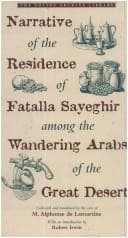
Narrative of the residence of Fatalla Sayeghir among the wandering Arabs of the great desert — John Shaqi
Narrative of the residence of Fatalla Sayeghir among the wandering Arabs of the great desertLamartine, Alphonse de
History
Narrative of the residence of Fatalla Sayeghir among the wandering Arabs of the great desert
Lamartine, Alphonse de
Arabian Peninsula -- Description and travel
We were told a thousand traits of his simplicity: amongst others,
that being at Damascus whilst Yousouf Pacha, the grand vizier of the
Porte, was holding his court there on his return from Egypt after the
departure of the French, Mehanna was presented to him, as well as the
other grandees; but, being little acquainted with Turkish etiquette, he
accosted him without ceremony and with the Bedouin mode of salutation,
and placed himself on the divan by his side without being invited.
Yousouf, equally unaccustomed to the usages of the Bedouins, and
ignorant of the dignity of the little shabby old man who treated him
with such familiarity, ordered him to be taken from his presence and
beheaded. The slaves took him out, and were preparing to execute the
order, when the Pacha of Damascus cried aloud, “Hold! what is it you
are doing? If there should fall a hair of his head, with all your
power, you will never send another caravan to Mecca.” The vizier
instantly had him brought back, and placed him by his side; he gave him
coffee, had him invested with a rich Cachemire turban, a rich gombaz
(robe,) and a pelisse of honour, and presented him with a thousand
piastres. Mehanna, deaf, and besides not understanding Turkish, knew
nothing of what was passing; but taking off the fine clothes, he gave
them to three of his slaves who accompanied him. The vizier asked
him, through the dragoman, if he was not satisfied with the present.
Mehanna replied, “Tell the vizier of the sultan, that we Bedouins seek
not to distinguish ourselves by fine clothes: I am ill clad, but all
the Bedouins know me; they know that I am Mehanna el Zadel, the son of
Melkghem.” The pacha, not daring to offend him, affected to smile, and
to be much pleased.
Public-domain text, read in full here on John Shaqi.
Reviews
Reviews
No reviews yet
Be the first to share your thoughts on this work.
Join the Discussion
Join the discussion
Sign in to leave a comment or review.
Sign InorCreate an account