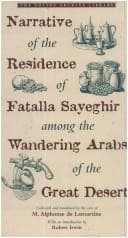
Narrative of the residence of Fatalla Sayeghir among the wandering Arabs of the great desertLamartine, Alphonse de
History
Narrative of the residence of Fatalla Sayeghir among the wandering Arabs of the great desert
Lamartine, Alphonse de
Arabian Peninsula -- Description and travel
Should this recital possess any interest in a scientific, a
geographical, or a political point of view, I have only one wish to
form; it is that the French government, which such a period of peril
and exile was intended to enlighten and serve, should show a tardy
gratitude towards the unfortunate Fatalla Sayeghir, whose services
might even still be useful. In this wish I include too the young and
skilful interpreter, M. Mazolier, who has translated these notes from
the Arabic, and who accompanied me for a year in my travels in Syria,
Galilee, and Arabia. Versed in the knowledge of Arabic, the son of an
Arab mother, nephew of one of the most powerful and revered sheiks of
Lebanon, having already traversed all those countries with me, familiar
with the manners of the tribes, a man of courage, intelligence and
honour, heartily devoted to France, this young man might be of the
utmost service to the government in our relations with Syria. French
nationality terminates not with our frontiers. Our country has sons as
attached upon shores whose name she scarcely knows. M. Mazolier is one
of those sons. France should not forget him. No one could serve her
better than he, in countries in which the effects of our activity of
civilization, protection, and even of policy, must soon be necessarily
felt. The following is the narrative of Fatalla Sayeghir, literally
translated.
NARRATIVE
OF
FATALLA SAYEGHIR.
At eighteen years of age I quitted Aleppo, my country, with a stock of
merchandise, to establish myself in Cyprus. Being tolerably fortunate
in the first year of my commercial speculations, I took a liking
to the business, and adopted the fatal idea of taking to Trieste a
cargo of the productions of the island. In a short time my goods were
embarked; they consisted of cotton, silk, wine, sponge, and colocynth.
On the 18th March, 1809, my ship, commanded by Captain _Chefalinati_,
set sail. I was already calculating the profits of my venture, and
rejoicing at the idea of the gross returns, when, in the midst of my
delightful illusions, the fatal news arrived of the capture of the
vessel by an English ship of war, which had taken her to Malta. In
consequence of such a loss, I was obliged to strike my balance, and
retire from trade; and I quitted Cyprus totally ruined, and returned to
Aleppo. Some days after my arrival I dined at one of my friends’ with
several persons, amongst whom was a stranger, very ill-dressed, but
to whom much consideration was shown. After dinner there was music;
and the stranger sitting beside me, conversed with much affability: we
spoke of music, and after a long conversation, I rose to ask him his
name. I learned that it was M. Lascaris de Ventimiglia, and that he was
a knight of Malta. The following day, I saw him coming to my house,
holding in his hand a violin. “My good young man,” said he on entering,
“I remarked yesterday how much you like music; I already look upon you
Public-domain text, read in full here on John Shaqi.
Reviews
Reviews
No reviews yet
Be the first to share your thoughts on this work.
Join the Discussion
Join the discussion
Sign in to leave a comment or review.
Sign InorCreate an account