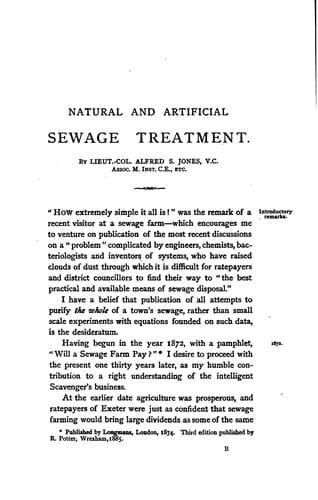
Natural & Artificial Sewage TreatmentJones, Alfred Stowell
Science
Natural & Artificial Sewage Treatment
Jones, Alfred Stowell
Sewage
1. On a farm at some distance from roads and houses, the cheapest plan
is to form a bank of earth about 18 inches high, enclosing a
rectangular area into which the wet sludge can be run or pumped out of
depositing tanks, and left alone until dry enough for cartage, when it
can be used on the farm or sold to neighbouring farmers for a shilling
or two a load.
2. A wall of farmyard _long_ manure may be used instead of earth, and
trench 5 feet wide dug on each side of the longer sides of the
rectangle, leaving 3 feet of ground between the wall and trench, on
which men can stand to scoop the sludge over the wall when it has
consolidated a little in the trench; the latter is then ready to
receive the sludge from another tank emptying, which is again scooped
over the wall on to a thin coating of farmyard manure, which has been
scattered over the last layer of sludge in the rectangle; and thus in
a year’s time a solid mass of the mixture is raised four or five feet
high, and is in capital order for putting in drills for a crop of
mangold wurtzel.
This is the plan in use at the Camp Farm; it occupies little ground
and smells only like rotten dung does during the few days carting to
the mangold field.
3. Pressing by compressed air forcing a liquid mixture of sludge and
lime into the interstices between cloths supported by vertical iron
plates on a horizontal frame; and such pressing is a very expensive
process, only resorted to when the sewage works are in a confined
populated district where no accumulation of sludge can be tolerated.
[Sidenote: Expert examination of neighbourhood a very necessary
preliminary to any sewage scheme.]
Before any sewage scheme is conceived a very careful survey of the
neighbourhood ought to be made by a person who knows the requisites of
a site for sewage disposal, especially if land irrigation is intended,
because natural advantages of site both for tanks, main carriers,
roads, etc., may make all the difference in the world in expense and
efficiency not only in first cost of works but also in their use
afterwards.
And if land is to be acquired for sewage farming it will be very
desirable to include in the purchase some neighbouring high lying
area, not required for sewage disposal but for growing straw crops to
be used on the farm.
CROPPING A SEWAGE FARM.
[Sidenote: Vegetation of some kind, useful or weeds, _will_ grow from
sewage, and must be frequently removed from land or contact bed.]
This is a matter of vital importance, because when sewage is
_intermittently_ applied to land of any kind or to coke beds,
vegetation of some kind or other must result and must be removed in
order to leave a clear course for the next dose of sewage; the cost of
removal and destruction of weeds will be found very great when contact
beds are tried on any working scale and would be quite prohibitive if
allowed to grow on irrigated land.
Public-domain text, read in full here on John Shaqi.
Reviews
Reviews
No reviews yet
Be the first to share your thoughts on this work.
Join the Discussion
Join the discussion
Sign in to leave a comment or review.
Sign InorCreate an account