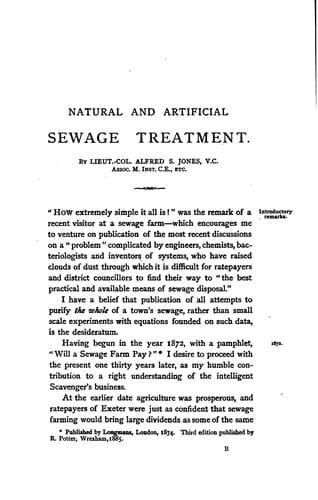
Natural & Artificial Sewage TreatmentJones, Alfred Stowell
Science
Natural & Artificial Sewage Treatment
Jones, Alfred Stowell
Sewage
Hence we must crowd out the weeds as much as possible by useful plants
which will bring something towards the cost of their removal; and as
that return from perishable greenstuff is dependent upon its immediate
sale or consumption on the farm, the manager must cast about for
demands for his abundant supply; but as both the sunshine (in this
climate) and markets are very capricious factors in the problem, he
has no easy task always to make both ends meet.
Theoretically the town which yields the sewage ought to provide an
abundant demand, but in practice it can rarely be depended upon,
Edinburgh being the only exception, where the Craigentinny sewage
meadows are rented at a very high figure by the cow-keepers of a city
situated in the heart of an arable district.
[Sidenote: Alternative destinations for vegetation thus removed. Milk
(everywhere in demand) or a destructor furnace.]
Fortunately, however, there is always an unlimited demand for milk,
and if he has the means of keeping a herd of cows on the farm, or can
arrange with a neighbouring cow-keeper to take all the grass and roots
he can supply at a low rate, it is about the best course a manager can
adopt.
If he maintains a herd of cows, tied up in good, well ventilated
stables, and has them daily brushed and groomed like horses, they
require no exercise and produce milk in perfection for an average
period of fifteen months from date of purchase after their third or
fourth calving.
Such a herd will consume rye-grass carted from the field from April to
November, and mangolds, kohl-rabi, and rye-grass hay during the
winter, thus securing a uniform demand for produce of the sewage land
throughout the year, and such cows will only require a little cotton
cake and oat straw bedding (of which latter they eat a good deal) to
fit them for sale to the butcher as soon as they become dry.
The advantage of such a steady demand is so great when rye-grass and
mangolds, etc., are indicated as the main crops of the farm, owing to
the large volume of sewage per acre, that the system of cow-keeping is
forced upon managers, however reluctant their sanitary authorities may
be to provide the necessary working capital, unless they can find a
reliable contractor to receive at a fixed price any quantity of grass
and roots the authority may grow and deliver.
[Sidenote: Permanent pasture grazed and for hay available in certain
cases.]
When a town has more land in proportion to its sewage, permanent
pasture may take the place of Italian rye-grass, and, with proper
precautions, a part of the permanent pasture may be grazed; but the
saving of labour, thus supposed to result from letting animals bite
and carry their food, is expended in making up, in a necessarily
imperfect manner, the carriers trodden in by the cattle.
[Sidenote: Importance of neat tidy contour carriers, correctly
levelled.]
Public-domain text, read in full here on John Shaqi.
Reviews
Reviews
No reviews yet
Be the first to share your thoughts on this work.
Join the Discussion
Join the discussion
Sign in to leave a comment or review.
Sign InorCreate an account