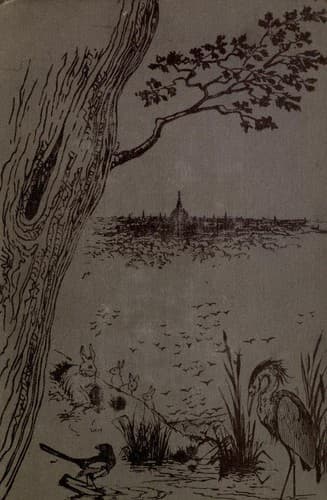
Country life -- England; Natural history -- Outdoor books; Nature study
If in the withey, they choose a spot where the rods cross or bunch
together. If in the sedges, though so close it seems as if you could
reach forward and catch him, he is behind the stalks. To place some
obstruction between themselves and any one passing is their custom: but
that spring, as the foliage was so thin, it only needed a little
dexterity in peering to get a view. The sedge-bird perches aside, on a
sloping willow rod, and, slightly raising his head, chatters, turning
his bill from side to side. He is a very tiny bird, and his little eye
looks out from under a yellowish streak. His song at first sounds
nothing but chatter.
After listening a while the ear finds a scale in it--an arrangement and
composition--so that, though still a chatter, it is a tasteful one. At
intervals he intersperses a chirp, exactly the same as that of the
sparrow, a chirp with a tang in it. Strike a piece of metal, and besides
the noise of the blow, there is a second note, or tang. The sparrow's
chirp has such a note sometimes, and the sedge-bird brings it in--tang,
tang, tang. This sound has given him his country name of brook-sparrow,
and it rather spoils his song. Often the moment he has concluded he
starts for another willow stole, and as he flies begins to chatter when
halfway across, and finishes on a fresh branch.
But long before this another bird has commenced to sing in a bush
adjacent; a third takes it up in the thorn hedge; a fourth in the bushes
across the pond; and from farther down the stream comes a faint and
distant chatter. Ceaselessly the competing gossip goes on the entire day
and most of the night; indeed, sometimes all night through. On a warm
spring morning, when the sunshine pours upon the willows, and even the
white dust of the road is brighter, bringing out the shadows in clear
definition, their lively notes and quick motions make a pleasant
commentary on the low sound of the stream rolling round the curve.
A moorhen's call comes from the hatch. Broad yellow petals of
marsh-marigold stand up high among the sedges rising from the
greyish-green ground, which is covered with a film of sun-dried aquatic
grass left dry by the retiring waters. Here and there are lilac-tinted
cuckoo-flowers, drawn up on taller stalks than those that grow in the
meadows. The black flowers of the sedges are powdered with yellow
pollen; and dark green sword-flags are beginning to spread their fans.
But just across the road, on the topmost twigs of birch poles, swallows
twitter in the tenderest tones to their loves. From the oaks in the
meadows on that side titlarks mount above the highest bough and then
descend, sing, sing, singing, to the grass.
Public-domain text, read in full here on John Shaqi.
Reviews
Reviews
No reviews yet
Be the first to share your thoughts on this work.
Join the Discussion
Join the discussion
Sign in to leave a comment or review.
Sign InorCreate an account