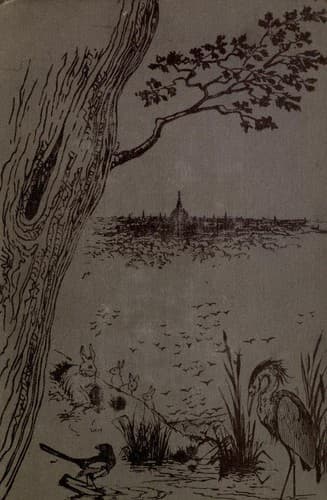
Country life -- England; Natural history -- Outdoor books; Nature study
A jay calls in a circular copse in the midst of the meadow; solitary
rooks go over to their nests in the elms on the hill; cuckoos call, now
this way and now that, as they travel round. While leaning on the grey
and lichen-hung rails by the brook, the current glides by, and it is the
motion of the water and its low murmur which renders the place so idle;
the sunbeams brood, the air is still but full of song. Let us, too, stay
and watch the petals fall one by one from a wild apple and float down on
the stream.
But now in autumn the haws are red on the thorn, the swallows are few as
they were in the earliest spring; the sedge-birds have flown, and the
redwings will soon be here. The sharp points of the sword-flags are
turned, their edges rusty, the forget-me-nots are gone. October's winds
are too searching for us to linger beside the brook, but still it is
pleasant to pass by and remember the summer days. For the year is never
gone by; in a moment we can recall the sunshine we enjoyed in May, the
roses we gathered in June, the first wheatear we plucked as the green
corn filled. Other events go by and are forgotten, and even the details
of our own lives, so immensely important to us at the moment, in time
fade from the memory till the date we fancied we should never forget has
to be sought in a diary. But the year is always with us; the months are
familiar always; they have never gone by.
So with the red haws around and the rustling leaves it is easy to recall
the flowers. The withey plantation here is full of flowers in summer;
yellow iris flowers in June when midsummer comes, for the iris loves a
thunder-shower. The flowering flag spreads like a fan from the root,
the edges overlap near the ground, and the leaves are broad as
sword-blades, indeed the plant is one of the largest that grows wild. It
is quite different from the common flag with three grooves--bayonet
shape--which appears in every brook. The yellow iris is much more local,
and in many country streams may be sought for in vain, so that so fine a
display as may be seen here seemed almost a discovery to me.
They were finest in the year of rain, 1879, that terrible year which is
fresh in the memory of all who have any interest in out-of-door matters.
At midsummer the plantation was aglow with iris bloom. The large yellow
petals were everywhere high above the sedge; in one place a dozen, then
two or three, then one by itself, then another bunch. The marsh was a
foot deep in water, which could only be seen by parting the stalks of
the sedges, for it was quite hidden under them. Sedges and flags grew so
thick that everything was concealed except the yellow bloom above.
Public-domain text, read in full here on John Shaqi.
Reviews
Reviews
No reviews yet
Be the first to share your thoughts on this work.
Join the Discussion
Join the discussion
Sign in to leave a comment or review.
Sign InorCreate an account