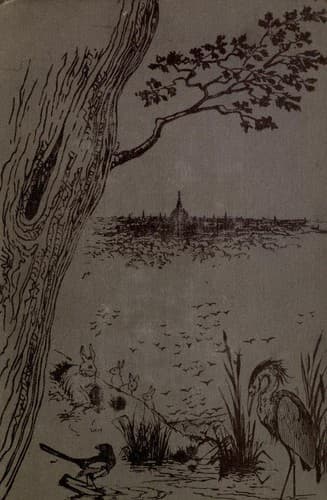
Country life -- England; Natural history -- Outdoor books; Nature study
One bunch grew on a bank raised a few inches above the flood which the
swollen brook had poured in, and there I walked among them; the leaves
came nearly up to the shoulder, the golden flowers on the stalks stood
equally high. It was a thicket of iris. Never before had they risen to
such a height; it was like the vegetation of tropical swamps, so much
was everything drawn up by the continual moisture. Who could have
supposed that such a downpour as occurred that summer would have had the
effect it had upon flowers? Most would have imagined that the excessive
rain would have destroyed them; yet never was there such floral beauty
as that year. Meadow-orchis, buttercups, the yellow iris, all the spring
flowers came forth in extraordinary profusion. The hay was spoiled, the
farmers ruined, but their fields were one broad expanse of flower.
As that spring was one of the wettest, so that of the year in present
view was one of the driest, and hence the plantation between the lane
and the brook was accessible, the sedges and flags short, and the
sedge-birds visible. There is a beech in the plantation standing so near
the verge of the stream that its boughs droop over. It has a number of
twigs around the stem--as a rule the beech-bole is clear of boughs, but
some which are of rather stunted growth are fringed with them. The
leaves on the longer boughs above fall off and voyage down the brook,
but those on the lesser twigs beneath, and only a little way from the
ground, remain on, and rustle, dry and brown, all through the winter.
Under the shelter of these leaves, and close to the trunk, there grew a
plant of flag--the tops of the flags almost reached to the leaves--and
all the winter through, despite the frosts for which it was remarkable,
despite the snow and the bitter winds which followed, this plant
remained green and fresh. From this beech in the morning a shadow
stretches to a bridge across the brook, and in that shadow my trout used
to lie. The bank under the drooping boughs forms a tiny cliff a foot
high, covered with moss, and here I once observed shrew mice diving and
racing about. But only once, though I frequently passed the spot; it is
curious that I did not see them afterwards.
Just below the shadow of the beech there is a sandy, oozy shore, where
the footprints of moorhens are often traceable. Many of the trees of the
plantation stand in water after heavy rain; their leaves drop into it in
autumn, and, being away from the influence of the current, stay and
soak, and lie several layers thick. Their edges overlap, red, brown,
and pale yellow, with the clear water above and shadows athwart it, and
dry white grass at the verge. A horse-chestnut drops its fruit in the
dusty road; high above its leaves are tinted with scarlet.
Public-domain text, read in full here on John Shaqi.
Reviews
Reviews
No reviews yet
Be the first to share your thoughts on this work.
Join the Discussion
Join the discussion
Sign in to leave a comment or review.
Sign InorCreate an account