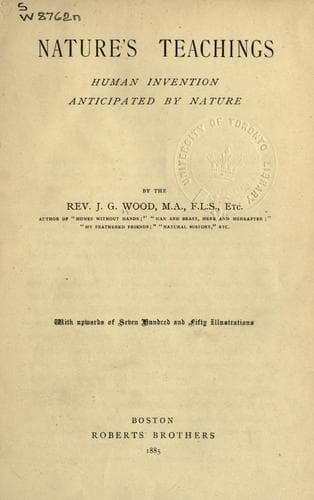
Nature's Teachings: Human Invention Anticipated by NatureWood, J. G. (John George)
History
Nature's Teachings: Human Invention Anticipated by Nature
Wood, J. G. (John George)
Inventions; Natural history
Perhaps the best, and certainly the most obvious, example of this
principle in the animal world is to be found in the skull of the
Elephant. The enormous tusks, with their powerful leverage, the massive
teeth, and the large and weighty proboscis, require a corresponding
supply of muscles, and consequently a large surface of bone for the
attachments of these muscles. Now, were the skull solid in proportion to
its requisite size, its weight would be too much for the neck to endure,
however short and sturdy it might be. The mode of attaining expanse of
surface, together with lightness of structure, is singularly beautiful.
Perhaps some of my readers may not be aware that the bone of the skull
consists of an outer and inner plate, with a variable arrangement of
cells between them. In many animals, such, for example, as man, where
the jaws are comparatively feeble, and the teeth small and light, the
size of the skull is practically that of the brain, to which it affords
a covering. The same structure may be observed in the skull of the
common sparrow, where, as in man, the two bony plates are set almost in
contact.
But in the elephant these external and internal plates are set widely
apart, and the space between them is filled with bony cells, much
resembling those of a honeycomb. They are, in fact, just the same cells
as those which exist in the skull of man and sparrow, but they are very
much enlarged, and in consequence give a large surface, accompanied with
united strength and lightness.
There are many other examples in the animal kingdom, but our limited
space will not allow them to be even mentioned.
* * * * *
AS to the vegetable examples of this principle, they are so
multitudinous that only a very slight description can be given of them.
I suppose that most boys have seen a “cane” (whether they have felt it
or not is not to the purpose), and some boys have made sham cigars from
pieces of cane. In either case they must have noticed that the cane is
not solid, but is pierced with a vast number of holes, passing
longitudinally through it, and is, in fact, a collection of little tubes
connected and bound together by a common envelope.
Public-domain text, read in full here on John Shaqi.
Reviews
Reviews
No reviews yet
Be the first to share your thoughts on this work.
Join the Discussion
Join the discussion
Sign in to leave a comment or review.
Sign InorCreate an account