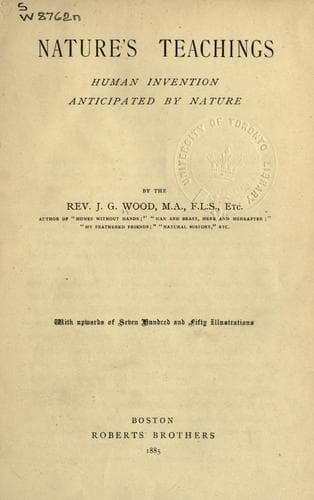
Nature's Teachings: Human Invention Anticipated by NatureWood, J. G. (John George)
History
Nature's Teachings: Human Invention Anticipated by Nature
Wood, J. G. (John George)
Inventions; Natural history
The Sugar-cane, if cut across, is seen also to consist of multitudinous
cells, which, however, are not hollow, but filled with the sweet liquid
from which sugar is obtained by boiling. Then there are many of our
common English plants, like the ordinary rush or reed, which are very
slight in diameter in comparison with their length, and in which the
cells are still further strengthened and lightened by the projection of
their sides into a number of points which meet each other, and leave
interstices between them. This modification of the cellular system is
called “Stellate” (or star-like) Tissue, and two examples of it are
given in the illustration, one being taken from the common rush, and the
other from the seed-coat of the privet. A very good specimen of stellate
tissue may be obtained by cutting a thin section of the white inner peel
of the orange.
NAUTICAL.
CHAPTER IV.
SUBSIDIARY APPLIANCES.--PART II.
The Cable and its Variations.--Material of Cables.--Hempen and Iron
Cables, and Elasticity of the latter.--Natural Cables.--The
“Byssus” of the Pinna and the common Mussel.--The Water-snail and
its Cable.--A similar Cable produced by the common White Slug.--The
Principle of Elasticity.--Elastic Cable of the Garden
Spider.--Tendrilous Cables of the Pea and the Bryony.--The
Vallisneria, and its Development through the Elastic
Cable.--Proposed Submarine Telegraph Cable.--The Anchor, Grapnel,
and their Varieties.--Natural Anchors.--Spicule of Synapta.--The
Grapnel, natural and artificial.--Ice-anchor and Walrus Tusks.--The
Mushroom Kedge.--The Flesh-hook.--Eagle-claw.--The Grapple-plant of
South Africa.--The Drag.
Among the most important accessories to a ship are the Cable, by which
she can be anchored to the bed of the sea, and the ropes called “warps,”
by which she can be fastened to the land.
Perhaps my readers may not know the old riddle--“How many ropes are
there on board a man-of-war?” The non-nautical individual cannot answer,
but the initiated replies that there are only three, namely, the
man-rope, the tiller-rope, and the rope’s-end, all the others being
“tacks,” “sheets,” “haulyards,” “stays,” “braces,” &c.
Formerly cables were always made of hemp, enormously thick, and most
carefully twisted by hand. Now, even in small vessels, the hempen cable
has been superseded by the iron chain, and this for several reasons.
In the first place, it is much smaller in bulk, and therefore does not
occupy so much room. In the next place, it is even lighter than the
hempen cable of corresponding strength; and, in the third, its specific
gravity--_i.e._ its weight when compared with an equal bulk of
water--is so great, that when submerged, it falls into a sort of
arch-like form, and so attains an elasticity which takes off much of the
strain on the anchor, and protects it from dragging.
* * * * *
WE will now look to Nature for Cables.
Public-domain text, read in full here on John Shaqi.
Reviews
Reviews
No reviews yet
Be the first to share your thoughts on this work.
Join the Discussion
Join the discussion
Sign in to leave a comment or review.
Sign InorCreate an account