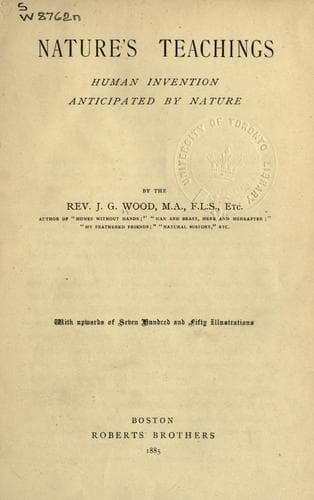
Nature's Teachings: Human Invention Anticipated by NatureWood, J. G. (John George)
History
Nature's Teachings: Human Invention Anticipated by Nature
Wood, J. G. (John George)
Inventions; Natural history
“Last summer (September 29) I met with the following unusual fact. In a
green-house, from a vine-leaf which was within a few inches of the glass
... a slug was hanging by a thread, which was more than four feet in
length, not unlike a spider-web, but evidently much stronger.
“The slug was descending by means of this thread, and, as the glutinous
matter from the under part of the body was drawn out by the weight of
the creature, it was consolidated into a compact thread by the slug
twisting itself in the direction of the hands of a clock, the power of
twisting being given by the head, and the part of the body nearest the
head being turned in the direction of the twist. There was no tendency
to turn in the contrary direction. Evidently the thread became hard as
soon as it was drawn away from the body.
“By wetting the sides of slips of glass, I secured two specimens of the
thread. In one of these, part was stretched, and part quite loose, the
latter appearing flat when seen through a microscope. The thread, which
was highly elastic, was increased about three inches in a minute. The
slug was white, and about an inch and a half in length.”
* * * * *
NOW we come to the elastic system of the Chain Cable, and find it
anticipated in Nature in various ways.
One curious example was that of a Spider, which found its wheel-like net
in danger from a tempestuous wind. The Spider descended to the ground, a
depth of about seven feet, and, instead of attaching its thread to a
stone or plant, fastened it to a piece of loose stick, hauled it up a
few feet clear of the ground, and then went back to its web. The piece
of stick thus left suspended acted in a most admirable manner, giving
strength and support, and at the same time yielding partly to the wind.
By accident the thread became broken, and the stick, which was about as
thick as an ordinary pencil, and not quite three inches in length, fell
to the ground. The Spider immediately descended, attached another
thread, and hauled it up as before. In a day or two, when the
tempestuous weather had ceased, the Spider voluntarily cut the thread,
and allowed the then useless stick to drop.
* * * * *
A CURIOUS example of the elastic cable is seen in the egg-case of the
Dog-fish, which is given on page 35. The egg-case is formed like that of
the common skate, and has a projection from each of its angles. But the
projections, instead of being mere flattened horns, are lengthened into
long elastic strings, tapering towards the ends, and twisted spirally,
like the tendrils of a grape-vine.
These tendril-like appendages twist themselves round seaweeds and other
objects, and, on account of their spiral form, can hardly ever be torn
from their attachments. Sometimes after a storm the egg is thrown on the
shore, still clinging to the seaweed, but to find an egg detached is
very rarely done.
Public-domain text, read in full here on John Shaqi.
Reviews
Reviews
No reviews yet
Be the first to share your thoughts on this work.
Join the Discussion
Join the discussion
Sign in to leave a comment or review.
Sign InorCreate an account