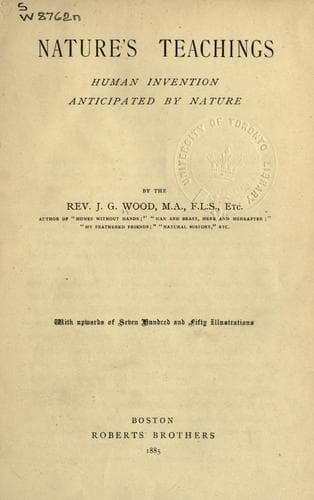
Nature's Teachings: Human Invention Anticipated by NatureWood, J. G. (John George)
History
Nature's Teachings: Human Invention Anticipated by Nature
Wood, J. G. (John George)
Inventions; Natural history
I have already mentioned the tendrils of the vine, and their great
strength. The reader may remember the corresponding cases of the Pea and
the Bryony, the latter being a most remarkable example of the strength
gained by the spiral form. It clambers about hedges, is exposed to the
fiercest winds, has large and broad leaves, and yet such a thing as a
Bryony being blown off a hedge is scarcely, if ever, seen. I never saw
an example myself, though I have had long experience in hedges.
* * * * *
ANOTHER excellent example of this principle is found in the Vallisneria
plant, which of late years has become tolerably familiar to us through
the means of fresh-water aquaria, though it is not indigenous to this
country.
In this plant the elastic power of the spiral cable is beautifully
developed. It is an aquatic plant, mostly found in running waters, and
has a most singular mode of development. It is diœcious--_i.e._ the
male, or stamen-bearing, and the female, or pistil-bearing flowers, grow
upon separate plants.
It has to deposit its seeds in the bed of the stream, and yet it is
necessary that both sets of flowers should be exposed to the air and sun
before they become able to perform their several duties. Add to this the
fact that the male flower is quite as small in proportion to the female
as is the case with the lac and scale insects, and the problem of their
reaching each other becomes apparently intricate, though it is solved in
a beautifully simple manner.
Fertilisation cannot be conducted by means of insects, as is the case
with so many diœcious terrestrial plants, and it is absolutely
necessary that actual contact should take place between them. This
difficult process is effected as follows:--
The female flowers are attached to a very long spiral and closely coiled
footstalk, and, when they are sufficiently developed, the footstalk
elongates itself until the flower rests on the surface of the water,
where it is safely anchored by its spiral cable, the coils yielding to
the wavelets, and keeping the flower in its place.
Meanwhile the tiny male flowers are being developed at the bottom of the
river, and are attached to very short footstalks. When they are quite
ripe they disengage themselves from their footstalks, and rise to the
surface of the river. Being carried along by the stream, they are sure
to come in contact with the anchored female flowers. This having been
done, and the seeds beginning to be developed, the spiral footstalk
again coils itself tightly, and brings the seeds close to the bed of the
stream, where they can take root.
There are other numerous examples, of which any reader, even slightly
skilled in botany, need not be reminded, most of them being, in one form
or another, modifications of the leaf or the petal, which, after all,
are much the same thing. The vine and passion-flower are, however,
partial exceptions.
Public-domain text, read in full here on John Shaqi.
Reviews
Reviews
No reviews yet
Be the first to share your thoughts on this work.
Join the Discussion
Join the discussion
Sign in to leave a comment or review.
Sign InorCreate an account