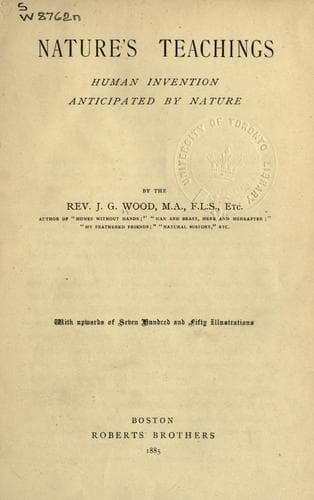
Nature's Teachings: Human Invention Anticipated by NatureWood, J. G. (John George)
History
Nature's Teachings: Human Invention Anticipated by Nature
Wood, J. G. (John George)
Inventions; Natural history
I may here mention that soon after the failure of the first Atlantic
telegraph cable, an invention was patented of a very much lighter cable,
enclosed in a tube of india-rubber, and being coiled spirally at certain
distances, so that the coils might give the elasticity which constitutes
strength. The cable was never made, its manufacture proving to be too
costly; but the idea of lightness and elasticity, having been evidently
taken from the spiral tendrils of the bryony, was certainly a good one,
and I should have wished to see it tried on a smaller scale than the
Atlantic requires.
* * * * *
AS a natural consequence, after the cable comes the Anchor, which in
almost every form has been anticipated by Nature, whether it be called
by the name of anchor, kedge, drag, or grapnel.
On the accompanying illustrations are shown a number of corresponding
forms of the Anchor, together with a few others, which, although they
may not necessarily be used in the water, are nevertheless constructed
on the same principle--_i.e._ for the purpose of grappling.
* * * * *
[Illustration: SPICULES OF SYNAPTA.]
[Illustration: ANCIENT ANCHOR.]
One of the most startling parallels may be seen on the right hand of the
illustration, the figure having been drawn from an old Roman coin. On
the other side of the same illustration may be seen an anchor so
exactly similar in form, that the outline of the one would almost answer
for that of the other. This object is a much-magnified representation of
a spicule which is found on the skin of the Synapta, one of the
so-called Sea-slugs, which are so extensively sold under the name of
Bêche de Mer. It forms one of the curious group called the Holothuridæ.
Each of these anchors is affixed to a sort of open-worked shield, as
shown above, and on the left hand; and it is a curious fact that in the
various species of Synapta the anchor is rather different in form, and
the shield very different in pattern. They are lovely objects, and I
recommend any of my readers who possess a microscope to procure one.
They need a power of at least 150 diameters to show their full beauties.
An ordinary Grapnel is here shown, and in the corresponding position on
the opposite side is an almost exactly similar object, except that it is
double, having the grapnel at both ends of the stem. This is a spicule
of a species of sponge, and is one of the vast numbers of which the
sponge principally consists.
[Illustration: LERNENTOMA.]
[Illustration: ECHINOCOCCUS.]
[Illustration: SPONGE-SPICULE.]
[Illustration: GRAPNEL.]
Next to the sponge-spicule is a still more perfect example of a natural
Grapnel. This is the head of an internal parasite called Echinococcus,
which holds itself in its position by means of the circle of hooks with
which the head is surrounded. These hooks are easily detached, and have
a curious resemblance to the claw of the lion or tiger.
Public-domain text, read in full here on John Shaqi.
Reviews
Reviews
No reviews yet
Be the first to share your thoughts on this work.
Join the Discussion
Join the discussion
Sign in to leave a comment or review.
Sign InorCreate an account