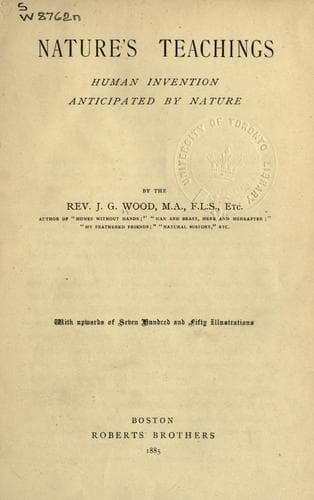
Nature's Teachings: Human Invention Anticipated by NatureWood, J. G. (John George)
History
Nature's Teachings: Human Invention Anticipated by Nature
Wood, J. G. (John George)
Inventions; Natural history
The last figure represents the head of the common Saw-fish, in which a
vast number of flat and sharply-edged teeth are set upon the blade-like
head. The fish has been observed to use this weapon just as the Mangaian
uses his sword-spear. It dashes among a shoal of fish, sweeps its head
violently backwards and forwards, and then, after they have dispersed,
picks up at its leisure the dead and disabled.
THE SPEAR AND THE DAGGER.
It is tolerably evident that the invention of the spear and dagger must
have been nearly, if not quite, contemporaneous with that of the club. I
place these weapons together because there is great difficulty in
assigning to either of them the precedence, the spear being but a more
or less elongated dagger, and the dagger a shortened spear.
As a good example of this fact, I have in my collection a number of
spears and daggers belonging to the Fan tribe of Western Africa. In
every case the weapons correspond so closely with each other, that if
the daggers were attached to shafts they would exactly resemble the
spears, and if the spears were cut off within a few inches of the head,
they would be taken for daggers.
I may here mention that as this part of the subject merely involves the
employment of a pointed or thrusting weapon, instead of the club or
sword, both of which are used for striking, the question of poison,
barbs, and sheaths will be treated on another page.
The primary origin of the Spear is probably the thorn, as a savage who
had been wounded by a thorn would easily pass to the conclusion that a
thorn of larger size would enable him to kill an enemy in war, or an
animal in hunting. Anything of sufficient dimensions, which either
possessed a natural point or could be sharpened into a point, would be
available for the purpose of the hunter or warrior.
Accordingly we find that such objects as the beak of the heron or stork,
the sharp hind-claw of the kangaroo, the bone of the sting-ray, the beak
of the sword-fish, and many similar objects, are employed for the heads
of spears, or used simply as daggers.
As to artificial spears, nothing is easier than to scrape a stick to a
point, and then, if needful, to harden it in the fire. This is, indeed,
one of the commonest forms of primitive spears, and I have in my
collection many examples of such weapons. Another simple form of this
weapon is that which is made by cutting a stick or similar object
diagonally.
Hollow rods--such, for example, as the bamboo--are the best for this
purpose. I have now before me a cast of a most interesting weapon
discovered by Colonel Lane Fox. It is the head of a spear, and is formed
from part of the leg-bone of a sheep. At one end there is a simple round
hole, which acted as a socket for the reception of the shaft, and the
other end is cut away diagonally, so as to leave a tolerably sharp
point.
Public-domain text, read in full here on John Shaqi.
Reviews
Reviews
No reviews yet
Be the first to share your thoughts on this work.
Join the Discussion
Join the discussion
Sign in to leave a comment or review.
Sign InorCreate an account