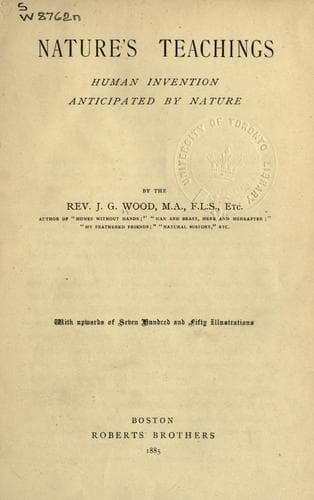
Nature's Teachings: Human Invention Anticipated by Nature — John Shaqi
Nature's Teachings: Human Invention Anticipated by NatureWood, J. G. (John George)
History
Nature's Teachings: Human Invention Anticipated by Nature
Wood, J. G. (John George)
Inventions; Natural history
As to the bamboo, it has a great advantage in the thinness of its walls,
and the coating of flinty substance with which it is surrounded, and
which gives its edges a knife-like sharpness. Indeed, so very sharp is
the silex, that splinters of bamboo are still used as knives, and with
them a skilful operator can cut up a large hog as expeditiously as one
of our pork-butchers could do with the best knife that Sheffield
produces.
I possess several of these weapons, and formidable arms of offence they
are. If the reader can imagine to himself a toothpick, a foot or more in
length, made from bamboo instead of quill, and having its edges nearly
as sharp as a razor, he can realise the force of even so simple a
weapon. In the case of the bamboo, too, celerity of manufacture has its
value, for any one can make a couple of spears in less than as many
minutes. All he has to do is to cut down a joint of bamboo transversely,
and then with a diagonal blow of his knife at the other end to form the
point.
The force of such a weapon may be inferred from a remarkable combat that
took place some sixty years ago, when the roads were not so safe as they
are at present.
A gentleman, who happened to be a consummate master of the sword, was
going along the highway at night, and was attacked by two footpads, he
having no weapon but a bamboo cane.
One of them he temporarily disabled by a severe kick, and then turned to
the other, whom he found to be pretty well as good a swordsman as
himself, and to possess a good stick instead of a slight cane. The
footpad soon discovered the discrepancy of weapons, and with a sharp
blow smashed the cane to pieces, leaving only about eighteen inches in
his antagonist’s hand.
Almost instinctively Baron ---- sprang under the man’s guard, and dashed
the broken cane in his face. The footpad staggered with a groan, put his
hands to his face, and ran away, followed by his companion, who did not
desire another encounter with such an antagonist. When the victor
reached his destination, he found that the footpad’s face must have been
torn to pieces, for the clefts of the split bamboo were full of scraps
of skin, flesh, and whisker hair.
It is worthy of notice that the combination of the club and the dagger
is common to savage and civilised life, as may be seen by reference to
the illustration in page 53, where the wooden club of savage warfare and
the metal club and maces of civilisation are alike armed with a piercing
as well as a bruising apparatus. Mostly the dagger is on the head of the
mace or battle-axe, but, in some cases, the end of the handle acts as
the dagger, and the head as the axe or mace.
Public-domain text, read in full here on John Shaqi.
Reviews
Reviews
No reviews yet
Be the first to share your thoughts on this work.
Join the Discussion
Join the discussion
Sign in to leave a comment or review.
Sign InorCreate an account