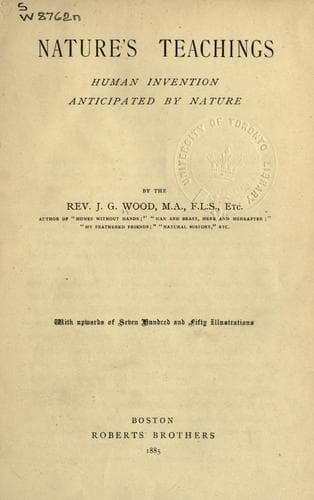
Nature's Teachings: Human Invention Anticipated by NatureWood, J. G. (John George)
History
Nature's Teachings: Human Invention Anticipated by Nature
Wood, J. G. (John George)
Inventions; Natural history
Laying a number of smaller logs or branches upon the bars which connect
the larger logs is an evident mode of forming a continuous platform, and
thus the raft is completed. It would not be long before the superior
buoyancy of a hollow over a solid log would be discovered, and so, when
the savage could not find a log ready hollowed to his hand, he would
hollow one for himself, mostly using fire in lieu of tools. The progress
from a hollowed log, or “dug-out,” as it is popularly called, to the
bark canoe, and then the built boat, naturally followed, the boats
increasing in size until they were developed into ships.
Such, then, is a slight sketch of the gradual construction of the Boat,
based, though perhaps ignorantly, on the theory of displacement. Now,
let us ask ourselves whether, in creation, there are any natural boats
which existed before man came upon the earth, and from which he might
have taken the idea if he had been able to reason on the subject. The
Paper Nautilus is, of course, the first example that comes before the
mind; but although, as we have seen, the delicate shell of the nautilus
is not used as a boat, and its sailing and rowing powers are alike
fabulous, there is, as is the case with most fables, a substratum of
truth, and there are aquatic molluscs which form themselves into boats,
although they do not propel themselves with sails or oars.
Many species of molluscs possess this art, but we will select one as an
example of them all, because it is very plentiful in our own country,
and may be found in almost any number. It is the common WATER-SNAIL
(_Limnæa stagnalis_), which abounds in our streams where the current is
not very strong. Even in tolerably swift streams the Limnæa may be found
plentifully in any bay or sudden curve where a reverse current is
generated, and therefore the force of the stream is partially
neutralised. These molluscs absolutely swarm in the Cherwell, and in the
multitudinous ditches which drain the flat country about Oxford into
that river as well as the Isis.
Belonging to the Gasteropods, the Water-snail can crawl over the stones
or aquatic vegetation, just as the common garden snail or slug does on
land. But it has another mode of progression, which it very often
employs in warm weather. It ascends to the surface of the water,
reverses its position so that the shell is downward, spreads out the
foot as widely as possible, and then contracts it in the centre, so as
to form it into a shallow boat.
[Illustration: GNAT-EGG BOAT AND THREE EGGS.]
[Illustration: “DUG-OUT” BOAT OF VARIOUS PARTS OF THE WORLD.]
[Illustration: SEA-ANEMONE ACTING AS BOAT.]
[Illustration: WATER-SNAIL ACTING AS BOAT.]
[Illustration: BIRCH-BARK CANOE.]
[Illustration: PUPA SKIN OF GNAT ACTING AS BOAT.]
Public-domain text, read in full here on John Shaqi.
Reviews
Reviews
No reviews yet
Be the first to share your thoughts on this work.
Join the Discussion
Join the discussion
Sign in to leave a comment or review.
Sign InorCreate an account