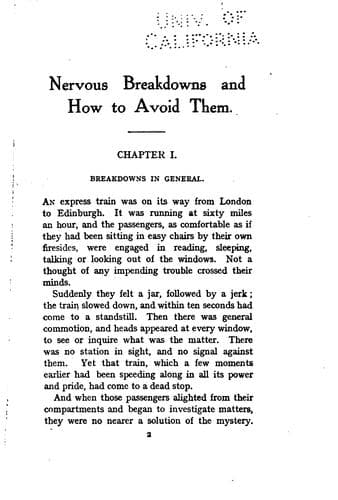
Nervous Breakdowns and How to Avoid ThemMusgrove, Charles David
Science
Nervous Breakdowns and How to Avoid Them
Musgrove, Charles David
Mental health
Yet not uncommonly it has turned out that those who have been
handicapped from the start have in the long run passed their more
robust comrades. It is not always the healthy baby that develops into
the hardiest member of the family. The puny little one has been known
to have the best of it in regard to health by the time it has grown up.
And when this happens it is simply a reward for taking care. Parents
are bound to pay more attention to a weakly child, while the robust
ones are often left to take their chance, and as they grow up into
boyhood and manhood, the delicate one has still to exercise care and
look after his health, if only for his own comfort. He knows, even in
his schooldays, that if he eats too much pastry or sweets, or neglects
to change his clothes if he gets a wetting, he will have to suffer for
it. All this time his hardy brother is running all sorts of risks, and
playing ducks and drakes with his digestion and his constitution in
general.
When they are approaching middle age, the strong one has developed into
a gouty, dyspeptic individual, who does not know what it is to feel
well for a single week at a time. And the weakly one may be better and
stronger than he has ever been in his life before.
He has never been able to do anything by leaps and bounds, but he has
plodded steadily on, exercising care and common sense, and looking
after his health in every possible way. It is another example of the
hare and the tortoise.
Two men were crossing a ship’s gangway, which had a rail at one side
but was unprotected on the other. The first was a frail, nervous man,
while his friend who followed him was a strong, lusty fellow. The
delicate one took care to keep a firm grip on the rail. He reached the
ship’s side in safety. The second man disdained to avail himself of its
aid, and walked up the gangway with his hands in his pockets, paying no
heed to his steps. Suddenly he lost his balance and fell into the water.
He scrambled out and cursed his bad luck. “He was the most unfortunate
beggar that ever lived,” he said. He completely lost sight of the fact
that it was his own carelessness which had brought about the mishap.
And it is a common occurrence to hear people, who have been running
all sorts of unnecessary risks, complaining of their bad fortune when
illness overtakes them. They get wet through and sit in their damp
clothes, and are very much aggrieved when they take a chill. Or they
gorge themselves with pastry or sweetmeats, and consider themselves
martyrs when they suffer from a bilious attack.
[Sidenote: The inevitable penalty.]
There is one penalty ever before us, that which must be paid by all who
transgress the laws of health. I say penalty, not punishment. A boy who
has purloined a plum cake and eaten inordinately of it may obtain his
mother’s forgiveness, but the chances are that he will be penalised by
having to endure a bout of stomach-ache.
Public-domain text, read in full here on John Shaqi.
Reviews
Reviews
No reviews yet
Be the first to share your thoughts on this work.
Join the Discussion
Join the discussion
Sign in to leave a comment or review.
Sign InorCreate an account