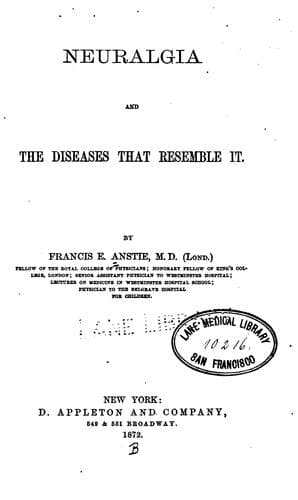
Neuralgia and the diseases that resemble itAnstie, Francis Edmund
Science
Neuralgia and the diseases that resemble it
Anstie, Francis Edmund
Neuralgia
neuralgic patients, by reason of the intellectual and emotional
characteristics of the latter. Both ideation and emotion are, indeed,
very often quick and active in the victims of neuralgia, who in this
respect differ strikingly from the majority of epileptics. But this
mobility of the higher centres of the nervous system is itself no sign
of general nervous strength; which last can never be possessed except by
those in whom a certain balance of the various nervous functions is
maintained. Much more will be said on this topic when we come to discuss
the etiology of neuralgia. Meantime I may content myself with repeating
the fact which is indubitably taught by careful observation--that
neuralgics are invariably marked by some original weakness of the
nervous system; though in some cases this defect is confined strictly to
that part of the sensory system which ultimately becomes the seat of
neuralgic pain.
Another circumstance is common to all neuralgias of superficial nerves;
and, as a large majority of all neuralgias are superficial in situation,
this is, for practical purposes, a general characteristic of the
disease. I refer to the gradual formation of tender spots at various
points where the affected nerves pass from a deeper to a more
superficial level, and particularly where they emerge from bony canals,
or pierce fibrous fasciæ. So general is this characteristic of
inveterate neuralgias, that Valleix founded his diagnosis of the genuine
neuralgias on the presence of these painful points. Herein he appears to
me to be decidedly in error. I have watched a great many cases (of all
sorts of varieties as to the situation of the pain), and I have
uniformly observed that in the early stages firm pressure may be made on
the painful nerve without any aggravation of the pain; indeed, very
often with the effect of assuaging it. The formation of tender spots is
a subsequent affair: they develop in those situations which have been
the foci, or severest points, of the neuralgic pain. There is however, a
point which, though not always, nor often, the seat of spontaneous pain,
is nevertheless very generally tender. Trousseau, who criticises
unfavorably the statement of Valleix as to the situation of the points
douloureux, insists that this tender spot, which is over the spinous
processes of the vertebræ corresponding to the origin of the painful
nerve, and which he calls the points apophysaire, is more universally
present than any of those pointed out by Valleix. I shall hereafter
endeavor to show that these spinal points are by no means characteristic
of neuralgia; they are present in a variety of affections which were
ably described, under the heading of "Spinal Irritation," many years
ago, by the brothers Griffin. ["Observations on the Functional
Affections of the Spinal Cord," by William and Daniel Griffin. London,
1834] and they are also present with misleading frequency in cases of
mere myalgia, such as I shall have to describe at a later stage.
Public-domain text, read in full here on John Shaqi.
Reviews
Reviews
No reviews yet
Be the first to share your thoughts on this work.
Join the Discussion
Join the discussion
Sign in to leave a comment or review.
Sign InorCreate an account