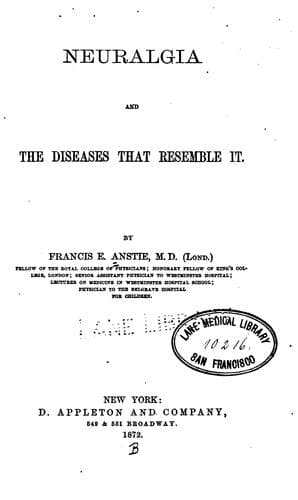
Neuralgia and the diseases that resemble itAnstie, Francis Edmund
Science
Neuralgia and the diseases that resemble it
Anstie, Francis Edmund
Neuralgia
Another characteristic of neuralgic patients in general is, I believe,
a certain mobility of the vaso-motor nervous system and of the cardiac
motor nerves; but I insist less on this than on the above-named
features, because a more extended experience is necessary to establish
the fact with certainty. Within my own experience it has always seemed
to be the case that persons who are liable to neuralgia are specially
prone to sudden changes of vascular tension, under emotional and other
influences which operate strongly on the nervous system. The observation
of this fact has been made accidentally, without any previous bias on my
part, in the course of a large number of experiments made upon
individuals free from manifest disease at the time, with Marey's
sphygmograph.
Neuralgic attacks are always intermittent, or at the least remittent, in
every stage of the disease.
The manner in which neuralgic pain commences is characteristic and
important. There is always a degree of suddenness in its outset. When
produced by a violent shock, it may, and often does, spring into full
development and severity at once, of which, perhaps, the most striking
example is the sudden and violent neuralgic pain of the eyebrow which
some persons experience from swallowing a lump of undissolved ice.
Usually, however, the first warning is a sudden, not very severe, and
altogether transient dart of pain. The patient has probably been
suffering from some degree of general fatigue and malaise, and the skin
of the affected part has been somewhat numb, when a sudden slight stitch
of pain darts into the nerve at some point which corresponds to one of
the foci hereafter to be particularized. It ceases immediately, but in a
few seconds or minutes returns; and these darts of pain recur more and
more frequently, till at last they blend themselves together in such a
manner that the patient suffers continuous and violent pain for a minute
or so, then experiences a short intermission, and then the pain returns
again, and so on. These intermittent spasms of pain go on recurring for
one or several hours; then the intermissions become longer, the pain
slighter, and at last the attack wears itself out. Such is generally the
history of first attacks, especially in subjects who are not past the
middle age, nor particularly debilitated from any special cause.
Public-domain text, read in full here on John Shaqi.
Reviews
Reviews
No reviews yet
Be the first to share your thoughts on this work.
Join the Discussion
Join the discussion
Sign in to leave a comment or review.
Sign InorCreate an account