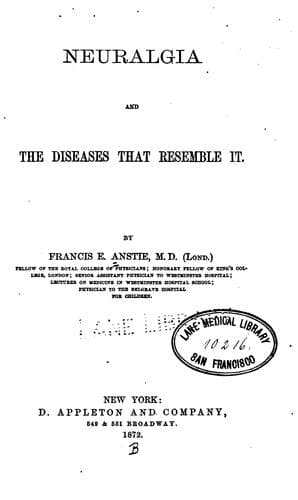
Neuralgia and the diseases that resemble itAnstie, Francis Edmund
Science
Neuralgia and the diseases that resemble it
Anstie, Francis Edmund
Neuralgia
As regards the relation of the syphilitic dyscrasia to neuralgia, I
agree in general with Eulenburg. "Syphilis," he says, "may be the direct
cause of neuralgia, either by the development of specific gummata in
the nerve-trunks or in the centres, or by arousing chronic irritative
processes in the nerve sheaths, the membranes of the brain and spinal
cord, or, especially, in the bones and periosteum (syphilitic osteitis
and periostitis)." The case of periostitis, however, is a doubtful one:
it may be questioned whether this affection (which will be among the
diseases discussed in Part II. of this work) ever give rise to true
neuralgia. Persons who are, by inheritance, highly predisposed to
neuralgia, may from the mere general lowering of their health produced
by constitutional syphilis, become truly neuralgic simultaneously with,
or subsequently to, the appearance of painful nodes on their bones. And
as regards the whole relations of syphilis to neuralgia, I must, from my
experience, conclude that the former is, after all, but rarely concerned
in the production of the latter. Syphilis has a strong specialty for
producing limited motor paralyses, but a much weaker one for producing
limited affections of the sensory system.
7. We now come to the discussion of a group of momenta whose influence
in the production of neuralgia is at once very powerful, and of the
highest significance as regards the general pathology of the disease.
These are the degenerative changes of the arterial and capillary systems
which are a part of the normal phenomena of old age, but may occur at
earlier periods of life, in consequence either of certain constitutional
diseases, especially gout, or of special toxic influences on nutrition,
of which persistent alcoholic excess is very far the most important.
Public-domain text, read in full here on John Shaqi.
Reviews
Reviews
No reviews yet
Be the first to share your thoughts on this work.
Elsewhere in the archive
Join the Discussion
Join the discussion
Sign in to leave a comment or review.
Sign InorCreate an account