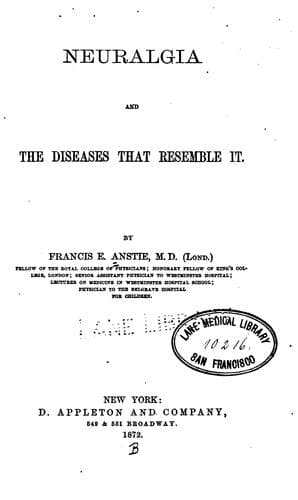
Neuralgia and the diseases that resemble itAnstie, Francis Edmund
Science
Neuralgia and the diseases that resemble it
Anstie, Francis Edmund
Neuralgia
1. Neuralgia from external shock may be produced by a physical cause (as
by a fall, a railway collision, etc.), which gives a jar to the central
nervous system; or by severe mental emotion, operating upon the same
part of the organism. Under either of these circumstances the
development of the affection may occur at once, but by far the most
frequently it ensues after a variable interval, during which the patient
shows signs of general depression, with loss of appetite and strength.
Sometimes vomiting, and in other instances paralysis, of a partial and
temporary kind, occur. When once developed, the neuralgic attacks do not
differ from those which proceed from causes internal to the organism. In
the greater number of instances, so far as my experience goes, it is the
fifth cranial nerve which becomes neuralgic from the effects of central
shock. Illustrative cases will be given in the section on Local
Classification. Meantime the important facts to note, in relation to the
influence of constitutional states, are these: In the first place, the
tendency of such accidents to excite neuralgia varies directly with the
hereditary predisposition evinced by the liability of the sufferer's
family to neuralgic affections and to the more serious neuroses.
Secondly, the likelihood of a neuralgic attack is indefinitely increased
if he has already had neuralgia. Thirdly, although debility from
temporary and special causes can rarely be sufficient to insure a true
neuralgic access after a severe shock, it probably heightens,
indefinitely, the tendency in a person otherwise predisposed. Delicate
women are many times more liable to experience such consequences, from a
physical or mental shock, than men of tolerably robust constitution.
2. Neuralgia from direct violence to superficial nerves is produced by
cutting or, more rarely, by bruising wounds. Cutting wounds may divide a
nerve-trunk (_a_) partially, or (_b_) completely.
(_a_) When a nerve-trunk is partially cut through, neuralgic pain
occurs, if at all, immediately, or almost immediately, on the receipt of
the injury. One such instance only has come under my own care, but many
others are recorded. In my case the ulnar nerve was partly cut through,
with a tolerably sharp bread-knife, not far above the wrist; partial
anæsthesia of the little and ring fingers was induced, but at the same
time violent neuralgic pains in the little finger came on, in fits
recurring several times a day, and lasting about half a minute.
Treatment was of little apparent effect in promoting a cure; though
opiates and the local use of chloroform afforded temporary relief. The
attacks recurred for more than a month, long after the original wound
had healed soundly; and, for a long time after this, pressure on the
cicatrix would reproduce the attacks. A slight amount of anæsthesia
still remained, when I saw the patient more than a year after the
injury.
Public-domain text, read in full here on John Shaqi.
Reviews
Reviews
No reviews yet
Be the first to share your thoughts on this work.
Join the Discussion
Join the discussion
Sign in to leave a comment or review.
Sign InorCreate an account