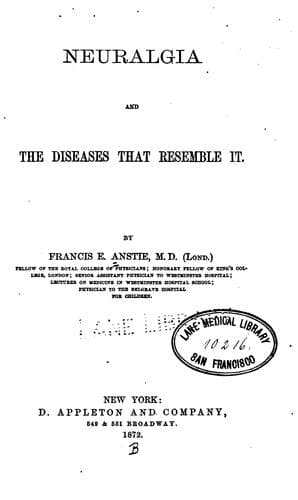
Neuralgia and the diseases that resemble itAnstie, Francis Edmund
Science
Neuralgia and the diseases that resemble it
Anstie, Francis Edmund
Neuralgia
A point of interest in connection with the natural history of the
neuralgic access is the condition of the circulation. The commencement
of pain is generally preceded by paleness of skin and sensations of
chilliness. At the commencement of the painful paroxysm, sphygmographic
observation shows that the arterial tension is much increased, owing, in
all probability, to spasm of the small vessels. This condition is
gradually replaced by an opposite state, the pulse becoming large, soft,
and bounding, though very unresisting, and giving a sphygmographic trace
which exhibits marked dicrotism. Simultaneously with this the skin
becomes warmer, sometimes even uncomfortably warm, and there is
frequently considerable flushing of the face.
The final characteristic common to all neuralgias is that fatigue, and
every other depressing influence, directly predispose to an attack, and
aggravate it when already existing.
_Varieties._--It is possible to classify neuralgias upon either of two
systems: first (_a_), according to the constitutional state of the
patient; and, secondly (_b_), according to the situation of the affected
nerves. It will be necessary to follow both these lines of
classification, avoiding all needless repetition.
(_a_) In considering the influence of constitutional states upon the
typical development of neuralgia, it will be convenient to commence with
the group of cases in which the general condition of the organism
produces the least effect. This is the case when the pain is the result
of direct injury to a nerve-trunk, whether by external violence, by the
mechanical pressure of a tumor, or by the involvement of a nerve in
inflammatory or ulcerative processes originating in a neighboring part.
As regards the development of symptoms, the important matters are, that
the pain in these cases commences comparatively gradually, that the
intermissions are usually more or less complete, and that the pain is
far less amenable to relief from remedies, than in other forms of
neuralgia. The little that can be said about the form which is dependent
upon progressively increasing pressure, or involvement of a nerve in
malignant ulcerations, caries of bones or teeth, etc., falls under the
heads of Diagnosis and Treatment, and need not detain us here. The
clinical history of neuralgia from external violence, however, requires
separate discussion:
Public-domain text, read in full here on John Shaqi.
Reviews
Reviews
No reviews yet
Be the first to share your thoughts on this work.
Join the Discussion
Join the discussion
Sign in to leave a comment or review.
Sign InorCreate an account