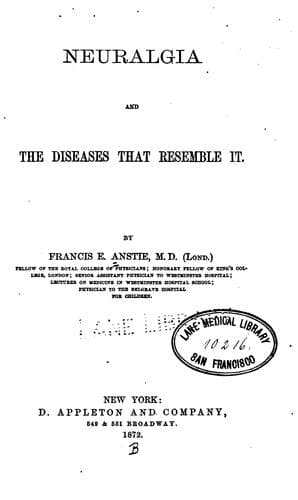
Neuralgia and the diseases that resemble itAnstie, Francis Edmund
Science
Neuralgia and the diseases that resemble it
Anstie, Francis Edmund
Neuralgia
Of these conflicting opinions I can have no difficulty in at any rate
rejecting that of Wegner; for the clinical phenomena of the
complications attending trigeminal neuralgia, such as they are described
in my last chapter (and could have been described at much greater
length), seem to me utterly to exclude vaso-motor spasm except as a
temporary phenomenon at the commencement of the attacks of acute pain.
Vaso-motor palsy undoubtedly is very often present, in fact every attack
of neuralgia of a certain severity is thus complicated; and there is no
reason to doubt that this paralysis could be caused by lesions within
the medulla. Are we, then, to admit functions of active dilatation of
vessels, and active impulse to secretion in certain fibres of the fifth?
It is necessary at any rate to clear the ground in one respect: it must
not be supposed that I for a moment entertain the idea that there can be
direct active dilatation, _i. e._, that there can be any system of
muscular fibres (and nerve-fibres stimulating them) whose office is to
open the calibre of the vessels; the idea is wildly improbable--in fact
almost inconceivable by any one who reflects on the necessary
machinery--and there is not a single observed anatomical fact to give it
support. If, then, I speak of the possibility of "active" dilatation, it
must be understood that I refer to a theory of "inhibition," which
supposes certain fibres to be gifted with the power of paralyzing or
inhibiting the vaso-motor nerves. It is my duty to speak with all
reasonable reserve on that most difficult _quæstio vexata_, the
existence of special inhibiting systems of nerves, and the extent to
which a double series of opposed nervous actions is generalized in the
body; but it is impossible to avoid the subject altogether, and I offer
the following remarks, with deference, to our professional
physiologists. The strongest instances of the apparent inhibiting action
are probably afforded by the _nervi erigentes_, as shown by Loven, the
cardiac depressor, by Ludwig and Cyon, and the splanchnics (upon the
intestine), by Pfluger. But there is not a single one of these examples
that has not been challenged by experimenters of repute. Thus the theory
of the distinctive restraint-action of the splanchnics upon the
intestine, and of the vagus upon the heart, has been especially
controverted by Piotrowski, who, indeed, rejects the whole theory of
special inhibitory nerves.[25] And, from another point of view, Mr.
Lister long ago attacked the views of Pfluger, maintaining that it was
possible to produce exactly opposite effects through the medium of the
very same nerves, according as the experimental irritation applied to
them was weak or strong. To Dr. Handfield Jones[26] this seems a still
unanswerable objection to the inhibitory theory. And in the remarkably
able and judicial summary of the "Physiology and Pathology of the
Sympathetic or Ganglionic System,"[27] by Dr. Robert T. Edes, a less
Public-domain text, read in full here on John Shaqi.
Reviews
Reviews
No reviews yet
Be the first to share your thoughts on this work.
Elsewhere in the archive
Join the Discussion
Join the discussion
Sign in to leave a comment or review.
Sign InorCreate an account