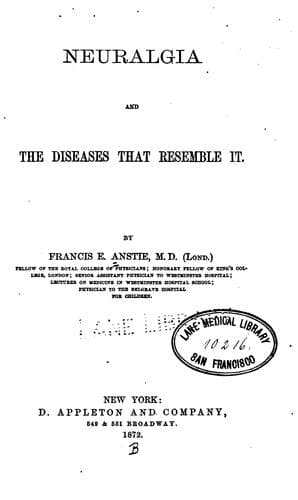
Neuralgia and the diseases that resemble itAnstie, Francis Edmund
Science
Neuralgia and the diseases that resemble it
Anstie, Francis Edmund
Neuralgia
be hereafter noted in connection with the subject of the pains of
locomotor ataxy and of those produced by profound mercurial poisoning.
And it will be seen in the section on Pathology, that very important
conclusions are suggested by the coincidence.
Joined with the burning pains, and the altered skin-nutrition, in the
cases of gunshot injury of nerves which we are considering, there is
nearly always a marked alteration in the temperature of the parts,
either in one direction or the other. In the great majority of instances
of ordinary neuralgia after wounds, this alteration is a very
considerable reduction of the temperature of the parts supplied by the
painful nerves; a change which corresponds with what appears in the vast
majority of all cases of division of sensitive nerves, whether pain be
set up or not. But, in all examples of the burning pain after injury,
Messrs. Mitchell, Moorehouse, and Keen found the temperature of the
painful parts notably elevated.
It would appear that there is no form of neuralgia more dreadful, and
scarcely any so hopeless, as this burning pain coming on as a sequel to
severe nerve injuries. It exercises a profoundly depressing effect upon
the whole nervous tone; the most robust men become timid and broken
down, and their condition is compared by the American writers to that of
hysterical women.
There is another peculiar nutritive affection, first recognized as an
occasional consequence of nerve injuries by Messrs. Mitchell,
Moorehouse, and Keen, namely, an inflammation of joints, and, although
we have no concern here with this symptom, it will be referred to
hereafter as throwing interesting light on certain questions of
pathology. Certain lesions of secretion will also be specially referred
to under the heading of Diagnosis.
II. NEURALGIAS OF INTRA-NERVOUS ORIGIN.--As regards the constitutional
conditions with which the several varieties of neuralgia that arise
independently of external violence, or disease of extra-nervous tissues,
are respectively allied, the following preliminary subdivisions may be
made:
1. Neuralgias of malarious origin.
2. Neuralgias of the period of bodily development.
3. Neuralgias of the middle period of life.
4. Neuralgias of the period of bodily decay.
5. Neuralgias associated with anæmia and mal-nutrition.
1. _Neuralgias of malarious origin_ were formerly far more prevalent
than they are at present, within the sphere of the English practitioner
of medicine; with the general decline of malarial fevers, consequent on
improved drainage and cultivation of lands, they have become constantly
more scarce. The districts in which they still are found to prevail with
any frequency are carefully specified in the interesting report of Dr.
Whitley to the Medical Officer of the Privy Council, in the Blue-Book
for 1863.
Public-domain text, read in full here on John Shaqi.
Reviews
Reviews
No reviews yet
Be the first to share your thoughts on this work.
Join the Discussion
Join the discussion
Sign in to leave a comment or review.
Sign InorCreate an account