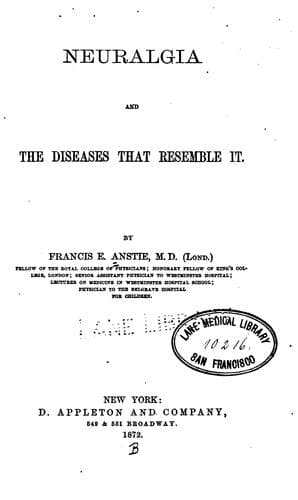
Neuralgia and the diseases that resemble it — John Shaqi
Neuralgia and the diseases that resemble itAnstie, Francis Edmund
Science
Neuralgia and the diseases that resemble it
Anstie, Francis Edmund
Neuralgia
Of course, however, there are a considerable number of persons
continually returning to England from countries where malarious diseases
are common; and these often bear about with them the effects of paludal
poisoning which occasionally exhibits itself in the form of neuralgia.
Till very lately, however, I had not happened to come across such cases,
although at one time and another I have seen and treated a good many
persons returned from India and Africa, whence I judge that neuralgia
with this special history is less common than many seem to think. In
former times, on the contrary, malarioid neuralgias were so common that
they forced themselves on the notice of every practitioner. The term
"brow-ague," to this day applied by many medical men to every variety of
supra-orbital neuralgia, is a relic of the older experience on this
point, as is also the very common mistake of expecting all neuralgic
affections to present a distinctly rhythmic recurrence of symptoms.
In the year 1864 I published the statement[6] that, "in a fair
sprinkling" of the cases of neuralgia which present themselves in
hospital out-patient rooms, ague-poisoning may be suspected; but I was
then speaking rather from hearsay than from my own experience, which, in
fact, had yielded no clear cases of this sort of neuralgia, and was till
just recently unable to reckon up more than two undoubted and one
doubtful case of the affection, in all of which the fifth cranial nerve
was unattacked. The periodicity in one of the genuine cases was regular
tertian, in the other regular quotidian. A semi-algide condition always
ushered in the attacks; but this was gradually exchanged, as the pain
continued, for a condition in which the pulse was rapid and locomotive,
but compressible, and the strength was further depressed. In both these
cases there was unilateral flushing of the face, and congestion of the
conjunctiva, to a slight degree, during the attack of pain. The pain
became duller and more diffused contemporaneously with the lowering of
arterial pressure; and, after the disappearance of active pain, moderate
tenderness over a considerable tract round the course of the painful
nerves remain for some time. There was no distinct development of
painful points in the situations described by Valleix; but it should be
remarked that the cases were rapidly cured with quinine, which very
probably accounts for this circumstance.
Public-domain text, read in full here on John Shaqi.
Reviews
Reviews
No reviews yet
Be the first to share your thoughts on this work.
Join the Discussion
Join the discussion
Sign in to leave a comment or review.
Sign InorCreate an account