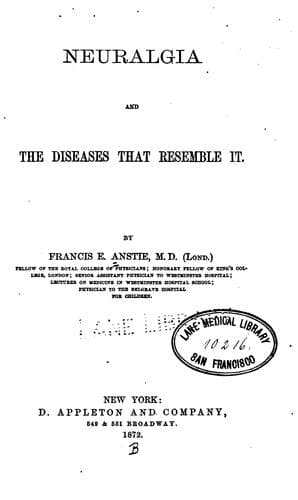
Neuralgia and the diseases that resemble itAnstie, Francis Edmund
Science
Neuralgia and the diseases that resemble it
Anstie, Francis Edmund
Neuralgia
I do not know that the poisonous action of any other metallic poison
than mercury has been distinctly shown to produce neuralgic pains of
superficial nerves. The action of lead is well known to produce colic, a
disease which will be specially dwelt on elsewhere. And undoubtedly a
certain amount of aching pain sometimes attends certain stages of
lead-palsy of the extensor muscles of the forearm. But I know of no
facts pointing to a true saturnine neuralgia. And the chronic poisonous
effects of arsenic on the nervous system seem to produce sensory
paralysis, rather than pain.
We come now to the consideration of the local varieties of neuralgia.
The primary subdivision of them may be made as follows:
I. Superficial Neuralgias. II. Visceral Neuralgias.
I. SUPERFICIAL NEURALGIAS.
Of superficial neuralgias a further classification may be made:
(_a_) Neuralgia of the fifth (trigeminal, or trifacial).
(_b_) Cervico-occipital neuralgia.
(_c_) Cervico-brachial neuralgia.
(_d_) Intercostal neuralgia.
(_e_) Lumbo-abdominal neuralgia.
(_f_) Crural neuralgia.
(_g_) Sciatic neuralgia.
This arrangement is that of Valleix, and appears to me substantially
correct.
(_a_) _Neuralgia of the Fifth._--The most important group of neuralgias
are those of the fifth cranial nerve.
Neuralgia of the fifth nerve always exhibits itself in the especial
violence in certain foci, which Valleix was the first to define with
accuracy. These foci are always in points where the nerve becomes more
superficial, either in turning out of a bony canal, or in penetrating
fasciæ. In the ophthalmic division of the nerve the following possible
foci are noticeable: (1) The supra-orbital, at the notch of that name,
or a little higher, in the course of the frontal nerve; (2) the
palpebral, in the upper eyelid; (3) the nasal, at the point of emergence
of the long nasal branch, at the junction of the nasal bone with the
cartilage; (4) the ocular, a somewhat indefinite focus within the globe
of the eye; (5) the trochlear, at the inner angle of the orbit.
In the superior maxillary division the following foci may be found: (1)
The infra-orbital, corresponding to the emergence of the nerve of that
name from its bony canal; (2) the malar, on the most prominent portion
of the malar bone; (3) a vague and indeterminate focus, somewhere on the
line of the gums of the upper jaw; (4) the superior labial, a vague and
not often important focus; (5) the palatine point, rarely observed, but
occasionally the seat of intolerable pain.
In the inferior maxillary division the foci are: (1) The temporal, a
point on the auriculo-temporal branch, a little in front of the ear; (2)
the inferior dental point, opposite the emergence of the nerve of that
name; (3) the lingual point, not a common one, on the side of the
tongue; (4) the inferior labial point, only rarely met with.
Public-domain text, read in full here on John Shaqi.
Reviews
Reviews
No reviews yet
Be the first to share your thoughts on this work.
Join the Discussion
Join the discussion
Sign in to leave a comment or review.
Sign InorCreate an account