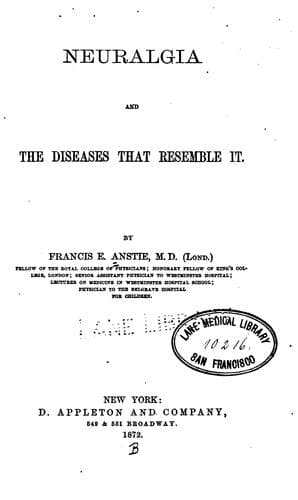
Neuralgia and the diseases that resemble itAnstie, Francis Edmund
Science
Neuralgia and the diseases that resemble it
Anstie, Francis Edmund
Neuralgia
Besides these foci in relation with distinct branches of the trigeminus,
there is one of especial frequency which corresponds to the inosculation
of various branches. This is the parietal point, situated a little above
the parietal eminence. It is small in size--the point of the little
finger would cover it. It is the commonest focus of all.
Neuralgia may attack any one, or all, of the three divisions of the
nerve; the latter event is comparatively rare. Valleix, indeed, holds a
different opinion; but this seems to me to arise from the fact that his
definition of neuralgia was too narrow to include a large number of the
milder cases of neuralgia, which are, nevertheless I believe, decidedly
of the same essential character with the severer affections. The most
frequent occurrence is the limitation of the pain to the ophthalmic
division, and incomparably the most frequent foci of pain are the
supra-orbital and the parietal.
The most common variety of trigeminal neuralgia is migraine, or
sick-headache, as it is often called. This is an affection which is
entirely independent of digestive disturbances, in its primary origin,
though it may be aggravated by their occurrence. It almost always first
attacks individuals at some time during the period of bodily
development. Under the influences proper to this vital epoch, and often
of a further debility produced by a premature straining of the mental
powers, the patient begins to suffer headache after any unusual fatigue
or excitement, sometimes without any distinct cause of this kind. The
unilateral character of this pain is not always detected at first; but,
as the attacks increase in frequency and severity, it becomes obvious
that the pain is limited to the supra-orbital and its twigs, with
sometimes also the ocular branches. In rare cases, as in all forms of
neuralgia, the nerves of both sides may be affected; I have already
observed that this seems to be relatively more common in young children.
If the pain lasts for any considerable length of time, nausea, and at
length vomiting, are induced. This is followed at the moment by an
increase in the severity of the pain, apparently from the shock of the
mechanical effect; but from this point the violence of the affection
begins to subside, and the patient usually falls asleep. The history of
the attacks negatives the idea that the vomiting is ordinarily remedial.
This symptom merely indicates the lowest point of nervous depression;
but it may happen that a quantity of food which has been injudiciously
taken, lying as it does undigested in the stomach, may of itself greatly
aggravate the neuralgia, by irritation transmitted to the medulla
oblongata. In such a case vomiting may directly relieve the nerve-pain.
When the patient awakes from sleep, the active pain is gone. But it is a
common occurrence--indeed it always happens when the neuralgia has
lasted a long time--that a tender condition of the superficial parts
Public-domain text, read in full here on John Shaqi.
Reviews
Reviews
No reviews yet
Be the first to share your thoughts on this work.
Join the Discussion
Join the discussion
Sign in to leave a comment or review.
Sign InorCreate an account