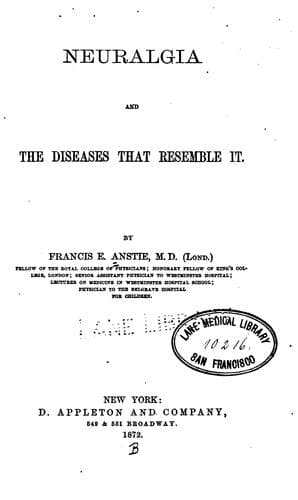
Neuralgia and the diseases that resemble it — John Shaqi
Neuralgia and the diseases that resemble itAnstie, Francis Edmund
Science
Neuralgia and the diseases that resemble it
Anstie, Francis Edmund
Neuralgia
remains for some hours, perhaps for a day or two. This tenderness is
usually somewhat diffused, and not limited with accuracy to the foci of
greatest pain during the attacks.
Sick headache is not uncommonly ushered in by sighings, yawning, and
shuddering--symptoms which remind us of the prodromata of certain graver
neuroses, to which, as we shall hereafter see, it is probably related by
hereditary descent. In its severer forms, migraine is a terrible
infliction; the pain gradually spreads to every twig of the ophthalmic
division; the eye of the affected side is deeply bloodshot, and streams
with tears; the eyelid droops, or jerks convulsively; the sight is
clouded, or even fails almost altogether for the time, and the darts of
agony which shoot up to the vertex seem as if the head were being split
down with an axe. The patient cannot bear the least glimmer of light,
nor the least motion, but lies quite helpless, intensely chilly and
depressed, the pulse at first slow, small and wiry, afterward more rapid
and larger, but very compressible. The feet are generally actually, as
well as subjectively, cold. Very often, toward the end of the attack,
there is a large excretion of pale, limpid urine.
Another variety of trigeminal neuralgia which infests the period of
bodily development is that known as clavus hystericus: clavus, from the
fact that the pain is at once severe, and limited to one or two small
definite points, as if a nail or nails were being driven into the skull.
These points correspond either to the supra-orbital or the parietal, or,
as often happens, to both at once. But for the greater limitation of the
area of pain in clavus, that affection would have little to distinguish
it from migraine, for the former is also accompanied with nausea and
vomiting when the pain continues long enough; and in both instances it
is obvious that there is a reflex irritation propagated from the painful
nerve. The adjective hystericus is an improper and inadequate definition
of the circumstances under which clavus arises. The truth is, that the
subjects of it are chiefly females who are passing through the trying
period of bodily development; but there is no evidence to show that
uterine disorders give any special bias toward this complaint. Both
migraine and clavus are often met with in persons who have long passed
their youth; but their first attacks have nearly always occurred during
the period of development.
Public-domain text, read in full here on John Shaqi.
Reviews
Reviews
No reviews yet
Be the first to share your thoughts on this work.
Join the Discussion
Join the discussion
Sign in to leave a comment or review.
Sign InorCreate an account