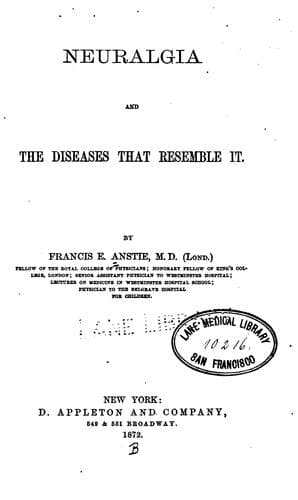
Neuralgia and the diseases that resemble itAnstie, Francis Edmund
Science
Neuralgia and the diseases that resemble it
Anstie, Francis Edmund
Neuralgia
There is a special cause of cervico-brachial neuralgias which is of more
importance than, till quite lately, has ever been recognized, namely,
reflex irritation from diseased teeth. The subject of these reflex
affections from carious teeth has been specially brought forward by Mr.
James Salter, in a very able and interesting paper in the "Guy's
Hospital Reports" for 1867; and Mr. Salter informs me that he has been
surprised by the number of cases of reflex affections, both paralytic
and neuralgic, of the cervico-brachial nerves, produced by this kind of
irritation, and that he agrees with me in thinking that a peculiar
organization or disposition of the spinal centres of these nerves must
be assumed in order to account for the fact.
The liability of particular nerves in the upper extremity to neuralgia
from external injuries requires a few words. The nerve which is probably
most exposed to this is the ulnar. Blows on what is vulgarly called the
funny-bone are not uncommon exciting causes of neuralgia in predisposed
persons, and cutting wounds of the ulnar a little above the wrist are
rather frequent causes. The deltoid branches of the circumflex and the
humeral cutaneous branches of the musculo-spiral are much exposed to
bruises and to cutting wounds. So far as I know, it is only when a nerve
trunk of some size has been wounded that neuralgia is a probable result.
Wounds of the small nervous branches in the fingers, for instance, are
very seldom followed by neuralgia. I have no statistics to guide me as
to the effect of long-continued irritation applied to one of these small
peripheral branches, but it is probable that that might be more capable
of inducing neuralgia. As far as my own experience goes, however, it
would appear that a more common result is convulsion of some kind, from
reflex irritation of the cord.
(_d_) _Dorso-intercostal Neuralgia._--This is one of the commonest
varieties of neuralgia, and yet it is very likely to be confounded with
other affections not neuralgic in their nature. The disorder with which
it is especially liable to be confounded is myalgia, which will be fully
described in another chapter, and which, when developed in the region of
the body to which we are now referring, is commonly spoken of as
pleurodynia, or lumbago (according as it affects the muscles of the back
or of the side), or muscular rheumatism. It must be owned that the
severer forms of this affection can scarcely be distinguished from true
intercostal neuralgia by anything in the character or situation of the
pains. It will be seen, hereafter, however, that myalgia has its own
specific history, which is very characteristic; at present, it is
sufficient to remember that it is often extremely like neuralgia when
situated in the dorso-intercostal region.
Public-domain text, read in full here on John Shaqi.
Reviews
Reviews
No reviews yet
Be the first to share your thoughts on this work.
Join the Discussion
Join the discussion
Sign in to leave a comment or review.
Sign InorCreate an account