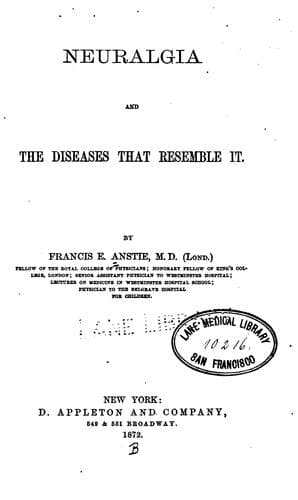
Neuralgia and the diseases that resemble itAnstie, Francis Edmund
Science
Neuralgia and the diseases that resemble it
Anstie, Francis Edmund
Neuralgia
Dorso-intercostal neuralgia is an affection of certain of the dorsal
nerves. These nerves divide, immediately after their emergence from the
intervertebral foramina, into an interior and a posterior branch. The
latter sends filaments which pierce the muscles to be distributed to the
skin of the back; the former, which are the intercostal nerves, follow
the intercostal spaces. Immediately after their commencement they
communicate with the corresponding ganglia of the sympathetic.
Proceeding outward, they at first lie between two layers of intercostal
muscles, and, after giving off branches to the latter, give off their
large superficial branch. In the case of the seventh, eighth and ninth
intercostal nerves, which are those most liable to intercostal
neuralgia, the superficial branch is given off about midway between the
spine and the sternum. The final point of division, at which superficial
filets come off, in all the eight lower intercostal nerves, is nearer to
the sternum; and is progressively nearer to the latter in each
successive space downward. There are thus, as Valleix observes, three
points of division: (1) At the intervertebral foramen; (2) midway in the
intercostal space; (3) near to the sternum. And there are three sets of
branches (reckoning the posterior division) which respectively make
their way to the surface near to these points.
In one of its forms, intercostal neuralgia is one of the commonest of
all neuralgic affections. I refer to the pain beneath the left mamma,
which women with neuralgic tendencies so often experience, chiefly in
consequence of over-suckling, but also from exhaustion caused by
menorrhagia or leucorrhoea, and especially from the concurrence of one
of the latter affections with excessive lactation. It is especially
necessary, however, to guard against mistaking for this affection a mere
myalgic state of the intercostal or pectoral muscles, which often
arises in similar circumstances with the addition of excessive or too
long continued exertions of these muscles. "Hysteric" tenderness also
sometimes bears a considerable resemblance, superficially, to true
intercostal neuralgia, in cases where the genuine disease does not
exist.
Public-domain text, read in full here on John Shaqi.
Reviews
Reviews
No reviews yet
Be the first to share your thoughts on this work.
Join the Discussion
Join the discussion
Sign in to leave a comment or review.
Sign InorCreate an account