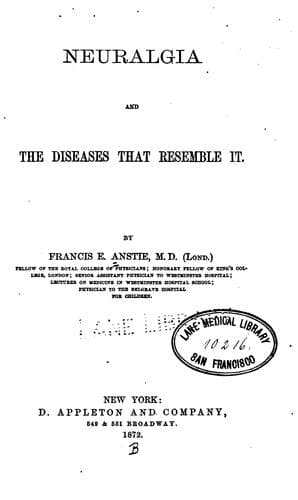
Neuralgia and the diseases that resemble itAnstie, Francis Edmund
Science
Neuralgia and the diseases that resemble it
Anstie, Francis Edmund
Neuralgia
The course of cardiac neuralgia varies extremely. Supposing the malady
to be purely neurotic, and not complicated with organic disease, which
forms a constant source of cardiac embarrassment, then the patient may
only experience one or two attacks, under some special circumstances of
exhaustion, which may never recur; or, on the other hand, he may develop
a strong tendency to cardiac neuralgia which may beset him during almost
any number of years. In the latter case, it is an even chance whether
the patient will at last sink from the anginal affection; for, even
supposing him to escape any fatal intercurrent disease of an independent
nature, the fatal event may be at last produced by cerebral softening,
or by apoplexy, or other central nervous disease. In fact, the frequency
with which the latter kind of termination occurs is very significant of
the essential nature of the disease.
The manner in which cardiac neuralgia commences varies very greatly. In
the celebrated case of Dr. Arnold, the first attack did not occur till
he was forty-seven years of age; it at once assumed full intensity, and
proved fatal in two hours and a half. There is also reason to believe
that Dr. Arnold's father died in a first attack of angina. I have myself
known a first attack prove fatal in the course of an hour; there was
very considerable ossification of the coronary arteries and fatty
degeneration of the heart-walls. Again, there are many cases which
commence gradually, and with great mildness, and with little appearance
of danger to life in the first attacks; but the subsequent attacks are
progressively more severe and dangerous up to a fatal result, after
weeks, months, or years. On the other hand, I have known three instances
in which the first attacks of spasmodic heart-pain very nearly proved
fatal, but the subsequent fits were milder (in one there was no second
attack): all those patients are living, six, eight, and three years
respectively, after their first attacks.
Public-domain text, read in full here on John Shaqi.
Reviews
Reviews
No reviews yet
Be the first to share your thoughts on this work.
Elsewhere in the archive
Join the Discussion
Join the discussion
Sign in to leave a comment or review.
Sign InorCreate an account