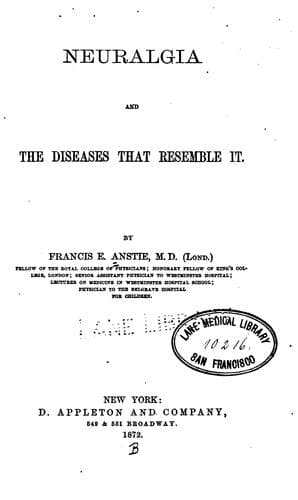
Neuralgia and the diseases that resemble itAnstie, Francis Edmund
Science
Neuralgia and the diseases that resemble it
Anstie, Francis Edmund
Neuralgia
It can hardly be doubted that neuralgic spasm is the true cause of
sudden death in some cases of stenosis of the aortic orifice, which, but
for some accidental circumstances, would not have died suddenly at all,
but would have gone through a long and gradual course of deterioration.
I particularly remember an instance in which extreme and calcareous
constriction of the aortic orifice, in a boy not yet come to puberty,
was entirely unsuspected, until one day, in running fast, he screamed
out and fell down, and was almost instantaneously dead. I remember
another case very similar, in which extreme mitral constriction produced
almost as sudden death, apparently from painful spasm, under the same
kind of exertion. On the other hand, sudden death, when produced by the
form of heart-disease which (as Dr. Walshe points out) is most likely to
cause such a catastrophe, viz., aortic regurgitation pure, without
hypertrophy, does not seem to be due to painful spasm, but to simple and
complete failure of the muscular power, and is perhaps partly of the
nature of paralysis from a syncopal condition of the brain, the
unhypertrophied heart having become for the moment unable to supply
blood enough to the brain to carry on nervous function at all.
A good instance of the form which angina takes, when the element of
organic cardiac change is well pronounced, was afforded by the case of a
young gentleman recently under my care. He was twenty-one years of age,
and from early boyhood had been accustomed to a great deal of muscular
exercise; in fact, it is probable that he had undermined his health by
the frequent and extraordinarily long walks which he took, for his frame
was particularly small and slight, and the muscles small and soft. He
came of a family in whom the tendency to neurotic disorders is obviously
very strong; both his father and his brother are subject to bad attacks
of migraine, and he had himself repeatedly suffered from the same thing.
The family disposition, altogether, is highly nervous and excitable. The
remarkable circumstance in this young gentleman's case is, that although
he had taken for years an extraordinary amount of pedestrian exercise
(including mountain-climbing), and latterly had exchanged this for the
even more trying exertion of rowing, he had never suffered from any
noticeable symptom of cardiac distress up to the very day of his anginal
attack. For some months, however, he had been growing thin and pale, and
I had given him certain cautions, and had made him take cod-liver oil
and steel, as I entertained some fears of his becoming phthisical. On
the day of the attack there was nothing particular in his appearance,
but he complained of a slight cold, and had no appetite for his six
o'clock dinner. He retired to rest at eleven o'clock, having taken a
small dose of laudanum and chloric ether for his cold. In less than half
an hour he awoke out of his sleep in fearful agony; so severe and
Public-domain text, read in full here on John Shaqi.
Reviews
Reviews
No reviews yet
Be the first to share your thoughts on this work.
Elsewhere in the archive
Join the Discussion
Join the discussion
Sign in to leave a comment or review.
Sign InorCreate an account