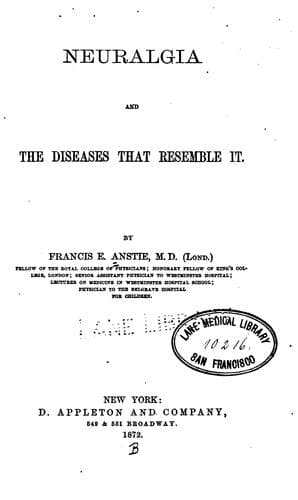
Neuralgia and the diseases that resemble itAnstie, Francis Edmund
Science
Neuralgia and the diseases that resemble it
Anstie, Francis Edmund
Neuralgia
prostrating was the anginoid pain that he had the greatest difficulty in
crawling out of bed to unlock his door. I found him bathed in cold
sweat, pale as a sheet, and with livid lips. He groaned with pain, which
he described as "cutting him across" from the sternal notch to the
nipple, and going down the left arm; and there was so marked a catching
of the breath as to make it almost certain that there was diaphragmatic
spasm; in fact, it was this which alarmed him, and made him say that he
was certainly dying. The heart, however, appeared to be pushed up
somewhat, and it was thought that this might be partly due to stomachic
distention, but a mustard emetic produced little effect. The
heart-sounds were so weak that the presence or absence of bruit could
not be safely predicated; meantime, the pulsations intermitted in a most
alarming manner. Large doses of brandy and sulphuric ether at length
(after several relapses) seemed to subdue the pain and spasm, and in an
hour and a half from the commencement of the attack the patient, though
utterly worn out, sank into a tolerably quiet sleep. The spasms did not
recur, but for the next three or four days he was in a state of great
exhaustion. When his tranquillity of mind had been somewhat restored, a
careful physical examination was made, and it was discovered that there
was a moderately loud and somewhat thrilling systolic bruit at the site
of the aortic valves, and extending some distance into the vessels. The
pulse still remained strikingly intermittent, and, though of fair
volume, was very compressible. Percussion indicated considerable
enlargement of the heart, and the physical signs pointed, on the whole,
to dilatation without hypertrophy. Some doubtful signs of consolidation
were observed at both apices of the lungs.
It is remarkable that, notwithstanding the serious degree of cardiac
mischief indicated by the above signs, the patient, a very few days
later, took a walk of some ten miles, and, though much exhausted,
suffered no recurrence of his formidable spasmodic symptoms in
consequence of this imprudence. He was sent to the mild climate of
Mentone, and subsequently to Nice; the angina never recurred, but the
patient remained weak, and liable to more or less dyspnoea for fifteen
or sixteen months; now he lives an ordinary life, doing his duty as a
Swiss citizen and officer. The cure of some hæmorrhoids, about twelve
months after the anginal attack, seemed greatly to benefit him. What the
future of this case may be it is impossible to say, but of course there
is no security against the angina recurring on extraordinary excitement
or over-exertion.
Public-domain text, read in full here on John Shaqi.
Reviews
Reviews
No reviews yet
Be the first to share your thoughts on this work.
Elsewhere in the archive
Join the Discussion
Join the discussion
Sign in to leave a comment or review.
Sign InorCreate an account