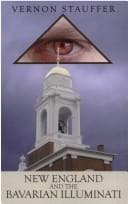
New England and the Bavarian IlluminatiStauffer, Vernon
History
New England and the Bavarian Illuminati
Stauffer, Vernon
Illuminati; New England -- Church history; Thesis (Ph. D.)
Such were the conditions of life under which the great mass of
the people lived. There was, however, a relatively small group of
cultivated people in Bavaria who, despite the clerical oppression
and bigotry from which they suffered, had contrived to share in the
liberalizing spirit of the larger world. The censorship exerted by the
Jesuits had found no adequate means to guard against the broadening
influences of travel or of contact with travelers from other lands, or
even to prevent the introduction of all contraband journals and books.
The effect of the former had been to create a humiliating and galling
sense of inferiority on the part of liberal-minded Bavarians,[304]
while the latter had served to stimulate a thirst for the new knowledge
which the rationalism of the age made available. To this small group of
discontented and ambitious spirits the ancient faith had ceased to be
satisfactory, and the burden of clericalism had become insufferable.
The University of Ingolstadt, established in 1472, was destined to
become a rallying point for these radical tendencies. In the middle of
the sixteenth century the Jesuits had gained control of its faculties
of philosophy and theology, and for two centuries thereafter the
university had been counted upon as the chief fortress of clericalism
in Bavaria.[305] By the middle of the eighteenth century the deadening
effect of the rigorous censorship exerted by the Jesuits had produced
its full fruitage at Ingolstadt. The university had fallen into a state
of profound decadence.[306]
With the accession of Maximilian Joseph[307] as elector, in 1745, the
breath of a new life soon stirred within its walls. For the position of
curator of the university the elector named a well-known and resolute
radical of the day, Baron Johann Adam Ickstatt, and charged him with
the responsibility of reorganizing the institution upon a more liberal
basis.[308] Measures were adopted promptly by the latter looking to the
restoration of the prestige of the university through the modernization
of its life. The ban was lifted from books whose admission to the
library had long been prohibited, chairs of public law and political
economy were established, and recruits to the faculty were sought in
other universities.[309]
Public-domain text, read in full here on John Shaqi.
Reviews
Reviews
No reviews yet
Be the first to share your thoughts on this work.
Elsewhere in the archive
Join the Discussion
Join the discussion
Sign in to leave a comment or review.
Sign InorCreate an account