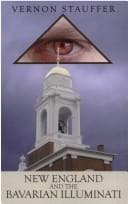
New England and the Bavarian IlluminatiStauffer, Vernon
History
New England and the Bavarian Illuminati
Stauffer, Vernon
Illuminati; New England -- Church history; Thesis (Ph. D.)
[93] Since the particular purpose of this chapter is to explain the
bitter spirit existing between the orthodox party and dissenters in
New England near the close of the eighteenth century, rather than to
re-write the history of the struggle for full religious toleration,
much that occurred in the long process of severing the bond between
church and state may be passed over. Attention will be focused upon the
character rather than the chronology of the struggle.
[94] Cobb, _The Rise of Religious Liberty in America_, p. 238; Fiske,
_The Beginnings of New England_, pp. 123 _et seq._
[95] Greene, _The Development of Religious Liberty in Connecticut_, p.
121; Cobb, _The Rise of Religious Liberty in America_, p. 243.
[96] Cobb, _op. cit._, pp. 244, 246.
[97] _Ibid._, pp. 240 _et seq._; Greene, _The Development of Religious
Liberty in Connecticut_, pp. 62 _et seq._, 68.
[98] It was the judgment of Isaac Backus that “oppression was greater
in Connecticut, than in other governments in New England”. (_History of
New England_, vol. ii, p. 404.)
[99] Cobb, _The Rise of Religious Liberty in America_, p. 244. Cobb’s
statement concerning the lack of harshness and ungentleness which
characterized the attitude of the supporters of the state church toward
dissent is extreme. The controlling spirit of the Standing Order was
doubtless a positive concern for the welfare of the Establishment
rather than a desire to weed out dissent; but the clash of interests
became so sharp and bitter that motives did not remain unmixed, and in
many an instance dissent in Connecticut was compelled to reckon with a
spirit of actual persecution.
[100] _The Public Records of the Colony of Connecticut_, vol. i, p. 21.
[101] Cobb, _The Rise of Religious Liberty in America_, pp. 246 _et
seq._
[102] _The Public Records of the Colony of Connecticut_, vol. i, p. 311.
[103] _Ibid._, pp. 356, 362; vol. ii, pp. 99, 240; vol. iii, pp. 78, 82
_et seq._
[104] _Ibid._, vol. iii, pp. 13, 18, 101, 216 _et seq._
[105] _Ibid._, vol. iv, pp. 67, 127, 136 _et seq._
[106] _Ibid._, vol. vii, p. 554.
[107] _Ibid._, pp. 334, 335.
[108] _Ibid._, vol. iii, p. 183.
[109] _Ibid._, vol. i, pp. 437 _et seq._
[110] _Ibid._, vol. iii, p. 104.
[111] Cobb, _The Rise of Religious Liberty in America_, p. 247.
[112] Walker, _The Creeds and Platforms of Congregationalism_, pp. 465
_et seq._
[113] Walker, _A History of the Congregational Churches in the United
States_, pp. 202 _et seq._; Greene, _The Development of Religious
Liberty in Connecticut_, pp. 133 _et seq._
[114] Walker, _The Creeds and Platforms of Congregationalism_, pp.
491–494.
[115] _The Public Records of the Colony of Connecticut_, vol. v, pp. 51
_et seq._
[116] _Ibid._
[117] _Ibid._
Public-domain text, read in full here on John Shaqi.
Reviews
Reviews
No reviews yet
Be the first to share your thoughts on this work.
Join the Discussion
Join the discussion
Sign in to leave a comment or review.
Sign InorCreate an account