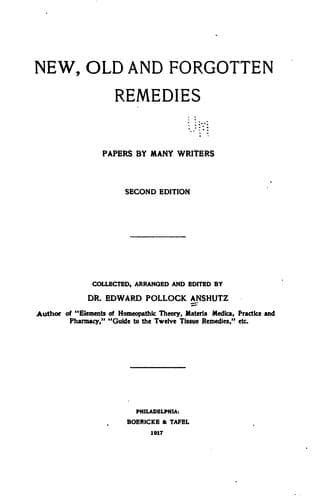
New, Old, and Forgotten Remedies: Papers by Many Writers
Science
New, Old, and Forgotten Remedies: Papers by Many Writers
Homeopathy -- Materia medica and therapeutics
2. Myxoedema. [The extirpation of the entire _Thyroid_ produces a
disease resembling myxoedema.]
3. Simple goitre.
4. Excessive obesity with tendency to weakness and anæmia.
5. Melancholia functional insanity, where improvement has taken place up
to a certain point and then remains so.
6. Defective secretion of milk during lactation when connected with
reappearance of menses. _Thyroid_ will suppress the latter and increase
and enrich the milk.
7. In fractures of the bones in which consolidation does not promptly
occur.
8. Hypertrophy of cicatricial tissue resembling keloid, possibly true
keloid.
_Doses:_ Either the fresh gland of the sheep prepared like food or the
extract, or in the dessicated state, of the latter may be given from 2-3
grs., or more or less, once a day (at night) or oftener.
The _Thyroid_ is _contra-indicated_ in tuberculous persons, as they are
apt to lose quickly in weight, over two pounds in twenty-four hours.
Rheumatic and anæmic symptoms are more frequently aggravated than
improved.
As the _Thyroid_ is a powerful remedy, the following should be always
remembered:
There is a decided difference with regard to individual toleration, some
are very susceptible.
The pulse should be watched regarding frequency and quality. The least
effort or exertion will increase it even to 160, hence some cases should
be kept in bed or at least very quiet and tranquil even for a time after
the remedy has been discontinued. Deaths have taken place after a few
days' treatment.
If _Thyroid_ is not taken for myxoedema the patient should be weighed
at least every two weeks, and if pathogenetic symptoms, called
thyroidism, appear the remedy should be discontinued or reduced.
If softening of the bones has been caused it may be necessary to
restrict the use of the legs or to use splints.
_Thyroid_ seems to have a cumulative effect.
In many cases a liberal diet should be prescribed to avoid injurious
consequences.
TRYCHOSANTHES DIOICA.
NAT. ORD., Cucurbitaceæ.
COMMON NAME, Patal.
PREPARATION.--One part of the entire fresh plant is macerated in two
parts by weight of alcohol.
(In 1893 H. L. Saha, homoeopathic practitioner, Pabna,
Bengal, sent the following to _Hom. Recorder_:)
_Trychosanthes dioica_ (Bengali name, Patal). It belongs to the order of
_Cucurbitaeæ_, is a creeper, flowering in all seasons, but chiefly in
spring. It is a native of Bengal. Its fruit is called Patal, and is used
by the natives as one of their chief curry.
The plant and its root are used by the native physicians in various
maladies. Its action is mainly upon the liver and intestines. The
decoction of the root is generally used by the mother physicians for
removing costiveness, especially where there is a derangement of the
functions of the liver.
Public-domain text, read in full here on John Shaqi.
Reviews
Reviews
No reviews yet
Be the first to share your thoughts on this work.
Elsewhere in the archive
Join the Discussion
Join the discussion
Sign in to leave a comment or review.
Sign InorCreate an account