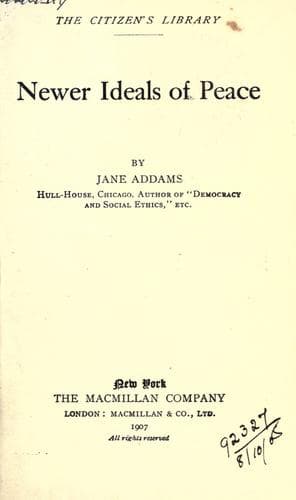
Municipal government -- United States; Peace; Political participation -- United States; Social justice; Working class -- United States
It would, however, be the height of folly for responsible statesmen
to ignore the sane methods of international discussion and concession
which have been evolved largely as a result of these appeals. The
Interparliamentary Union for International Arbitration and the
Institute of International Law represent the untiring efforts of the
advocates of peace through many years. Nevertheless universal peace,
viewed from the point of the World’s Sovereignty or of the Counsel of
Nations, is discouraging even when stated by the most ardent promoters
of the peace society. Here it is quite possible that the mistake is
being repeated which the old annalists of history made when they
never failed to chronicle the wars and calamities which harassed
their contemporaries, although, while the few indulged in fighting,
the mass of them peacefully prosecuted their daily toil and followed
their own conceptions of kindliness and equity. An English writer[1]
has recently bidden us to look at the actual state of affairs existing
at the present moment. He says, “Universal and permanent peace may be
a vision; but the gradual change whereby war, as a normal state of
international relations, has given place to peace as the normal state,
is no vision, but an actual process of history palpably forwarded in
our own day by the development of international law and of morals,
and voluntary arbitration based thereon.” He insists that it is the
function of international lawyers merely to give coherent expression
to the best principles which the common moral sense of civilized
Governments recognizes; in other words, that international law should
be like primitive law within the nation, a formal expression of custom
resting on the sense of a reciprocal restraint which has been found to
be necessary for the common good.
Assuming that the two lines of appeal--the one to sensibility and the
other to prudence--will persist, and that the international lawyers, in
spite of the fact that they have no court before which to plead and no
executive to enforce their findings, will continue to formulate into
codes the growing moral sense of the nations, the following pages hope
not only to make clear the contention that these forces within society
are so dynamic and vigorous that the impulses to war seem by comparison
cumbersome and mechanical, but also to point out the development of
those newer social forces which it is believed will at last prove a
“sovereign intervention” by extinguishing the possibility of battle at
its very source.
Public-domain text, read in full here on John Shaqi.
Reviews
Reviews
No reviews yet
Be the first to share your thoughts on this work.
Join the Discussion
Join the discussion
Sign in to leave a comment or review.
Sign InorCreate an account