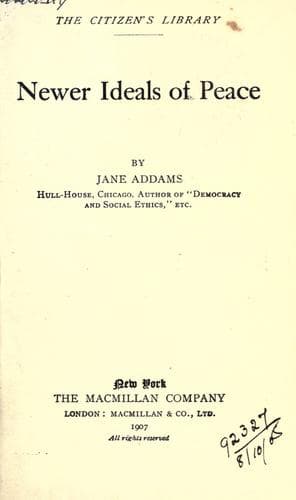
Municipal government -- United States; Peace; Political participation -- United States; Social justice; Working class -- United States
High and searching as is the preaching of these two great Russians who
hold their art of no account save as it serves moral ends, it is still
the appeal of dogma, and may be reduced to a command to cease from
evil. And when this same line of appeal is presented by less gifted
men, it often results in mere sentimentality, totally unenforced by a
call to righteousness.
The second line followed by the advocates of peace in all countries has
been the appeal to the sense of prudence, and this again has found its
ablest exponent in a Russian subject, the economist and banker, Jean de
Bloch. He sets forth the cost of warfare with pitiless accuracy, and
demonstrates that even the present armed peace is so costly that the
burdens of it threaten social revolution in almost every country in
Europe. Long before the reader comes to the end of de Bloch’s elaborate
computation he is ready to cry out on the inanity of the proposition
that the only way to secure eternal peace is to waste so much valuable
energy and treasure in preparing for war that war becomes impossible.
Certainly no theory could be devised which is more cumbersome, more
roundabout, more extravagant, than the _reductio ad absurdum_ of
the peace-secured-by-the-preparation-for-war theory. This appeal to
prudence was constantly emphasized at the first Hague Conference and
was shortly afterward demonstrated by Great Britain when she went to
war in South Africa, where she was fined one hundred million pounds
and lost ten thousand lives. The fact that Russia also, and the very
Czar who invited the Conference, disregarded the conclusions of the
Hague Tribunal makes this line of appeal at least for the moment seem
impotent to influence empires which command enormous resources and
which lodge the power of expenditure in officials who have nothing to
do with accumulating the treasure they vote to expend.
Public-domain text, read in full here on John Shaqi.
Reviews
Reviews
No reviews yet
Be the first to share your thoughts on this work.
Join the Discussion
Join the discussion
Sign in to leave a comment or review.
Sign InorCreate an account