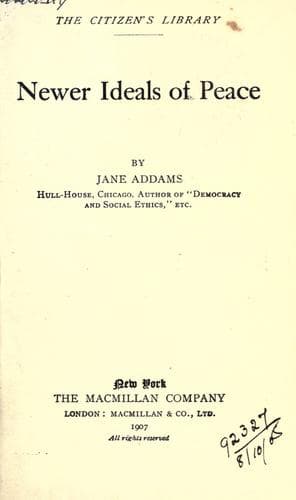
Municipal government -- United States; Peace; Political participation -- United States; Social justice; Working class -- United States
Upon some such basis as this the Hebrew Alliance and the Charity
Organization of New York, which are putting forth desperate energy in
the enormous task of ministering to the suffering which immigration
entails, are developing understanding and respect for the alien through
their mutual efforts to secure more adequate tenement-house regulation
and to control the spread of tuberculosis; both these undertakings
being perfectly hopeless without the intelligent co-operation of
the immigrants themselves. Through such humble doors, perchance,
the immigrant will at last enter into his heritage in a new nation.
Democratic government has ever been the result of spiritual travail
and moral effort. Apparently, even here, the immigrant must pay the
old cost, and he seems to represent the group and type which is making
the most genuine contribution to the present growth in governmental
functions, with its constant demand for increasing adaptations.
In the induction of the adult immigrant into practical citizenship,
we constantly ignore his daily experience. We also assume in our
formal attempts to teach patriotism to him and to his children, that
experience and traditions have no value, and that a new sentiment
must be put into aliens by some external process. Some years ago, a
public-spirited organization engaged a number of speakers to go to
the various city schools in order to instruct the children in the
significance of Decoration Day and to foster patriotism among the
foreign born, by descriptions of the Civil War. In one of the schools,
filled with Italian children, an old soldier, a veteran in years and
experience, gave a description of a battle in Tennessee, and of his
personal adventures in using a pile of brush as an ambuscade and a
fortification. Coming from the schoolhouse, an eager young Italian
broke out, with characteristic vividness, into a description of his
father’s campaigning under the leadership of Garibaldi, possibly
from some obscure notion that that, too, was a civil war fought from
principle, but more likely because the description of one battle
had roused in his mind the memory of another such description. The
lecturer, whose sympathies happened to be on the other side of the
Garibaldian conflict, somewhat sharply told him that he must forget
all that; that he was no longer an Italian, but an American. The
natural growth of patriotism based upon respect for the achievements
of one’s fathers, the bringing together of the past with the present,
the significance of the almost world-wide effort at a higher standard
of political freedom which swept over all Europe and America between
1848 and 1872 could, of course, have no place in the boy’s mind because
it had none in the mind of the instructor whose patriotism apparently
tried to purify itself by the American process of elimination.
Public-domain text, read in full here on John Shaqi.
Reviews
Reviews
No reviews yet
Be the first to share your thoughts on this work.
Join the Discussion
Join the discussion
Sign in to leave a comment or review.
Sign InorCreate an account