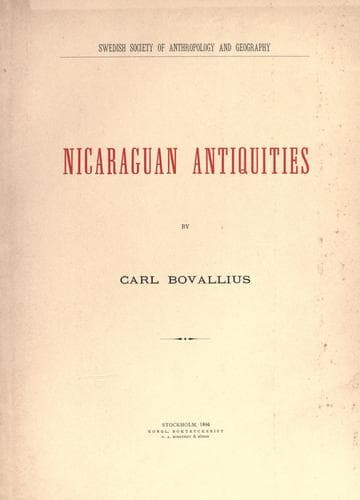
Indians of Central America -- Nicaragua -- Antiquities; Nicaragua -- Antiquities
Although this sketch is certainly not the place for an account of the
history of Central America or Nicaragua, yet I may be permitted to give
a brief statement of those few and disconnected notices that we possess
with regard to the nations inhabiting Nicaragua at that period, when
the antiquities here spoken of were probably executed. The sources of
our knowledge of these people and their culture are, besides the above
quoted work of SQUIER, the old Spanish chroniclers, OVIEDO, TORQUEMADA,
HERRERA, and GUARROS, the memoirs of LAS CASAS and PETER MARTYR, the
relation of THOMAS GAGE, and scattered notices in the works of GOMARA,
IXTLILXOCHITL, DAMPIER a. o.
* * * * *
At the time of the Spanish invasion under the command of _Don Gil
Gonzales de Avila_ in the years 1521 and 1522, the region now occupied
by the republic of Nicaragua and the north-eastern part of the republic
of Costa Rica, was inhabited by Indian nations of four different
stocks, which very probably may be considered as being of different
origin and having immigrated into the country at widely separated
periods.
The Atlantic coast with its luxuriant vegetation but damp climate and
the adjacent mountainous country with its vast primeval forests were
the home of more or less _nomadic tribes_, remaining at a low stage of
civilization. It may be inferred, however, from certain indications
in the account of the third voyage of Columbus, and from the scanty
notices of several of the so-called buccaneers or filibusters, that
those Indians were more advanced in culture and manner of life than the
hordes, that may be regarded as their descendants at the present day:
the _Moscos_, the _Ramas_, the _Simoos_ or _Smoos_ a. o.[2]
Between this strip of country on the eastern shore and the two great
lakes, _Xolotlan_ (Managua) and _Cocibolca_ (the lake of Nicaragua),
the intermediate highland, which shelves gradually towards the lakes,
was inhabited by los _Chontales_, as they are denominated by OVIEDO.
The name is still preserved in «Departemento de _Chontales_». They
lived in large villages and towns and were agriculturists. Possibly
they were of the same stock as, or closely related to, the large
_Maya_-family which extended over the eastern parts of Honduras and
Guatemala and furnished the population of Yucatan. This guess acquires
a certain probability by the fact of several words in their language
being similar to the corresponding ones in some Maya-dialects. The
_Poas_, _Toacas_, _Lacandones_, and _Guatusos_ may possibly be their
descendants. These also are living at a decidedly lower stage of
civilization than their supposed ancestors.
Public-domain text, read in full here on John Shaqi.
Reviews
Reviews
No reviews yet
Be the first to share your thoughts on this work.
Join the Discussion
Join the discussion
Sign in to leave a comment or review.
Sign InorCreate an account