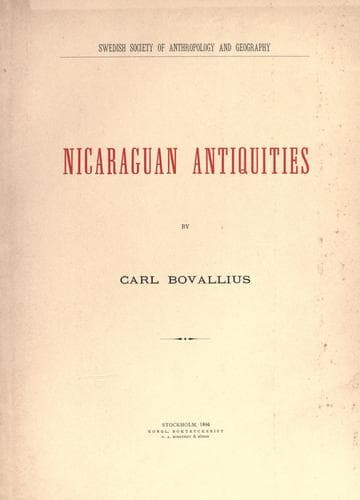
Indians of Central America -- Nicaragua -- Antiquities; Nicaragua -- Antiquities
[2] I cannot but contradict, on the ground of my own investigations,
the suggestion of Squier, that the nomadic tribes on the east coast of
Nicaragua were related to the Caribs, and especially «the Melchoras on
the river San Juan are certainly of Carib stock». All the individuals
of the Simoo, Rama and Melchora tribe, that I have seen and measured,
correspond far more, both in general habitus and cranial characters, to
the Talamanca Indians and Guatusos, indeed even to the Indios mansos in
Chontales and in Northern Nicaragua, than to the Caribs of Honduras who
are proved to be true Caribs, or to the Magdalena Indians in Columbia
who are supposed to belong to the Carib stock. The differences are so
great as to make it probable that Squier’s supposition arises from a
confusion of names, more particularly because the name of Caribs was
applied to all Indios bravos of eastern Nicaragua during the Spanish
time, long before the brave Caribs of S:t Vincent, the last remains
of that people in the West-Indies, after a long and hard struggle
for freedom were expatriated and carried to Ruatan, from where they
transmigrated afterwards of their own will to the opposite coast of
Honduras.
If the eastern part of Nicaragua, on account of its almost impenetrable
forests and damp climate, is less fit to be the dwelling-place of a
highly cultivated people, the western portion, on the contrary, is
much more happily endowed in this respect and seems to be marked
out by nature itself to become one of the centres of mankind’s
civilization. By its smiling valleys, fertile plains, and thinner, but
shadowy forests, by its splendid lakes, gently flowing rivers, and
verdant mountains the country appears well able to tempt even the most
exacting people to settle in it. Indeed the country, on the arrival
of the Spaniards, was found to be very densely populated, and divided
amongst a great number of small sovereignities, which could however be
referred to two separate stocks, differing in language and character.
One of these, the third one of those stocks from which has sprung the
population of Nicaragua, was los _Choroteganos_ or _Mangues_. They
occupied the territory between the two large lakes and all the fertile
level country west and north of Lake Managua down to the Pacific and
Bahia de Fonseca. OVIEDO asserts that they were the aborigines and
ancient masters of the country, without being able however to state any
proofs in support of his opinion. Of los _Choroteganos_ four groups
are usually distinguished: 1:0) Los _Cholutecas_ on the shores of
Bahia de Fonseca; their principal town was the present _Choluteca_.
2:0) Los _Nagrandanos_ between Lake Managua and the Pacific; their
capital was _Subtiaba_, near the present Leon. 3:0) Los _Dirianos_
between the lakes Managua and Nicaragua and down to the coast of the
Pacific. Their largest town was _Salteba_ near the present Granada and
4:0) Los _Orotinas_ far separated from their relations, inhabiting the
Public-domain text, read in full here on John Shaqi.
Reviews
Reviews
No reviews yet
Be the first to share your thoughts on this work.
Join the Discussion
Join the discussion
Sign in to leave a comment or review.
Sign InorCreate an account