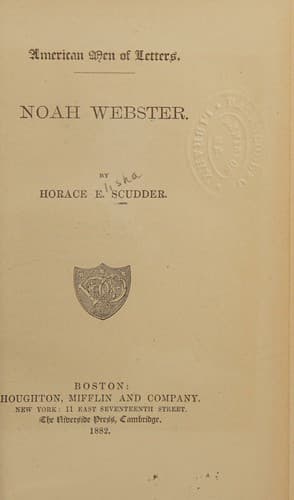
Noah Webster: American Men of LettersScudder, Horace Elisha
History
Noah Webster: American Men of Letters
Scudder, Horace Elisha
Educators -- United States -- Biography; Lexicographers -- United States -- Biography; Webster, Noah, 1758-1843
The most of the succeeding numbers had reference to politics, but room
was found for excursions in other fields: "Monier's Advertisement for a
School," and "Newtonian Philosophy," served as pegs from which to hang
rhymed jests, and the writers would very likely have taken a wider range
if there had been a wider range in public interests. But politics
dominated thought, and the wits were as bitter partisans as they were
clever rhymesters. The poetry of the anti-Jacobin supplied them with the
suggestion of form; but there was not the lightness of touch or deft
mimicry which characterized those remarkable political skits. As one
reads the "Echo," and the "Green-house," and Trumbull's "McFingal," he
is constantly reminded of the heaviness of the education which formed
the substance of the writers' preparation for their task. The rudeness
of the satire is the rudeness of a homespun society.
The authors of the "Echo," when the series came to be reissued in a
volume, provided a somewhat solemn preface, in which they say: "The
principal poems in this volume, under the title of the 'Echo,' owed
their origin to the accidental suggestion of a moment of literary
sportiveness, at a time when pedantry, affectation, and bombast pervaded
most of the pieces published in the gazettes, which were then the
principal vehicles of literary information. Willing to lend their aid to
check the progress of false taste in American literature, the authors
conceived that ridicule would prove a powerful corrective, and that the
mode employed in the 'Echo' was the best suited to this purpose.... But
the ridicule of a vitiated mode of writing was not long the sole object
of the 'Echo.' The important political changes which soon after
occurred, not only in Europe, but in America, produced a corresponding
change in the republic of letters; and some of the principal gazettes of
this country exhibited a disgusting display, not only of a perversion of
taste in composition, but a still greater perversion of principle, in
that hideous morality of revolutionary madness, which, priding itself in
an emancipation from moral obligation, leveled the boundaries of virtue
and vice, while it contemptuously derided the most amiable and sacred
feelings of our nature. Disgusted with the cruelties exhibited by the
French Revolution at a very early stage of its progress, and viewing it
as a consuming fire, which, in the course of its conflagration,
threatened to destroy whatever was most valuable in society, the authors
wished to contribute their efforts in stemming the torrents of
Jacobinism in America, and resolved to render the 'Echo' subservient to
that purpose. They therefore proceeded to attack, as proper objects of
satire, those tenets, as absurd in politics as pernicious in morals, the
visionary scheme of equality, and the baleful doctrine that sanctions
the pursuit of a good end by the most flagitious means."
Public-domain text, read in full here on John Shaqi.
Reviews
Reviews
No reviews yet
Be the first to share your thoughts on this work.
Join the Discussion
Join the discussion
Sign in to leave a comment or review.
Sign InorCreate an account