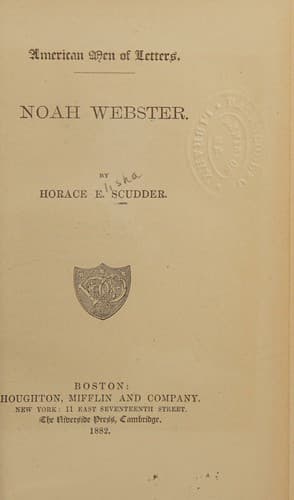
Noah Webster: American Men of Letters — John Shaqi
Noah Webster: American Men of LettersScudder, Horace Elisha
History
Noah Webster: American Men of Letters
Scudder, Horace Elisha
Educators -- United States -- Biography; Lexicographers -- United States -- Biography; Webster, Noah, 1758-1843
Webster's judgment of the condition of literature in the country at a
time when he was seeking to live by it is contained in a frank statement
which he makes in one of his letters to Dr. Priestley. That philosopher
had addressed certain letters to the inhabitants of Northumberland, in
which he undertook to lecture them as a philosophical and wise
Englishman might properly lecture the citizens of a young and
inexperienced republic. Webster replied in ten letters and a
postscript, which were collected into a pamphlet and published at New
Haven, in 1800. He contends throughout that Dr. Priestley did not know
his countrymen, and especially that he was ignorant of New England; he
corrects his political judgments, but admits the force in general of his
social and literary criticisms. The picture which Webster draws of the
condition of America at the beginning of the century is instructive, and
explains, indeed, much of his own career:--
"I agree with you fully that our colleges are disgracefully destitute of
books and philosophical apparatus, and that a duty on books without
discrimination is highly impolitic. Very many of the best authors cannot
be printed in the United States for half a century or more; and I am
ashamed to own that scarcely a branch of science can be fully
investigated in America for want of books, especially original works.
This defect of our libraries I have experienced myself in searching for
materials for the history of Epidemic Diseases.
"In regard to the state of learning in general, your remarks are not
sufficiently discriminating. You say there is 'less knowledge in
America than in most of the countries of Europe.' The truth seems to be
that in the Eastern States knowledge is more diffused among the laboring
people than in any country on the globe. The learning of the people
extends to a knowledge of their own tongue, of writing and arithmetic
sufficient to keep their own simple accounts; they read not only the
Bible and newspapers, but almost all read the best English authors, as
the 'Spectator,' 'Rambler,' and the works of Watts, Doddridge, and many
others. If you can find any country in Europe where this is done to the
same extent as in New England, I am very ill informed.
"But in the higher branches of literature our learning is superficial to
a shameful degree. Perhaps I ought to except the science of law, which,
being the road to political life, is probably as well understood as in
Great Britain; and ethics and political science have been greatly
cultivated since the American Revolution. On political subjects I have
no hesitation in saying that I believe the learning of our eminent
statesmen to be superior to that of most European writers, and their
opinions more correct. They have all the authors on these subjects,
united with much experience, which no European country can have had.
This has enabled our statesmen to correct many of the theories which
lead astray European writers.
Public-domain text, read in full here on John Shaqi.
Reviews
Reviews
No reviews yet
Be the first to share your thoughts on this work.
Join the Discussion
Join the discussion
Sign in to leave a comment or review.
Sign InorCreate an account